Tag: Events
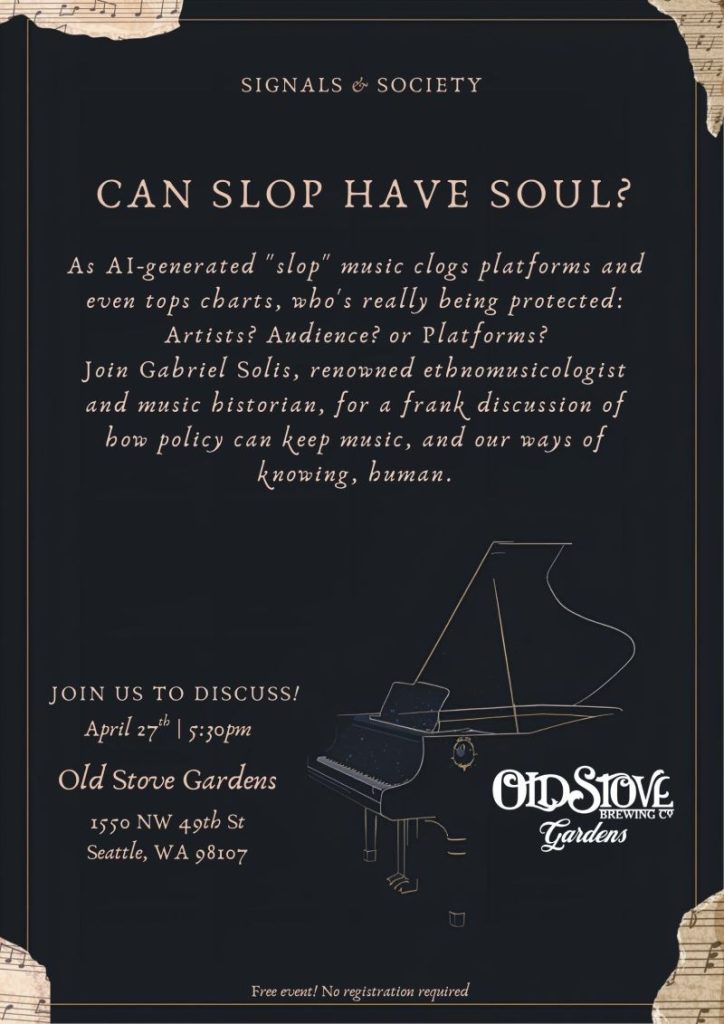
Next Signals & Society event on AI and music: Can Slop Have Soul? April 27, 2026 at Old Stone Gardens in Ballard
Society + Technology at UW is pleased to cross-promote the next event in the Signals & Society series, Can Slop Have Soul? an interactive discussion with ethnomusicologist and music historian Gabriel Solis (Music, UW Seattle) on the impact of AI on music, musicians, listeners, and the music industry.
Monday, April 27, 2026, at 5:30 PM
Old Stove Gardens (Ballard)
1550 NW 49th St, Seattle, WA 98107
Topics include:
- How AI is already shaping what we hear on streaming platforms
- Ways to center human creativity in an AI-saturated landscape
Musicians, listeners, industry professionals, and the AI-curious and AI-skeptical are welcome. This conversation will be an octave above the noise.
Free and open to the public. No registration required.
About Gabriel Solis
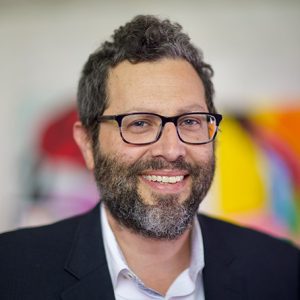
A professor of music at UW Seattle, Gabriel is an ethnomusicologist and music historian whose work focuses on music, memory, and racialization in the 20th and 21st centuries. He came to the University of Washington in 2022 from the University of Illinois, where he had been a professor of music for 20 years, with affiliate appointments in African American Studies, American Indian Studies, and Anthropology. In previous administrative appointments, he has striven to develop research capacity in the arts with a focus on intersections between scholarship and practice, and with a core commitment to building more equitable and inclusive approaches to the arts in higher education.
Gabriel Solis’s research in jazz, popular music, and contemporary Indigenous music in Australia and Melanesia has been supported by fellowships and grants from the National Endowment for the Humanities (NEH), Arts and Humanities Research Council (AHRC), and Mellon Foundation.
Solis also writes a Medium blog, where he’s covered, as he puts it, “slop: ai, music, and [gestures wildly] all of this!” https://medium.com/@gabrielsolis_1219
Register now for ‘The Risks and Realities of AI Chatbots’ event on April 7, 2026 at 6 PM at the Seattle Central Library

This article is crossposted from the Center for an Informed Public, and reproduced in full.
AI chatbots are everywhere. They answer questions, offer advice, and even provide emotional support. But what happens when they hallucinate or deliver unreliable information? Who’s responsible when these tools cause real harm?
Kashmir Hill of The New York Times and Jeff Horwitz of Reuters have been investigating questions like these for years. Hill has broken major stories on facial recognition, privacy, and AI systems. Horwitz’s reporting has exposed how tech companies handle harmful content, often revealing significant failures. Both have documented serious problems with how these technologies actually work in practice.
In a special conversation on April 7, 6-7:30 p.m. at the Seattle Central Library, moderated by Monica Nickelsburg, host of KUOW Public Radio’s Booming podcast, Hill and Horwitz will share what they’ve learned about AI chatbot harms. They’ll discuss dangerous misinformation, unexpected safety failures, and the question of corporate accountability. As chatbots become more common in our daily lives, what should users know? Where are the gaps in how these systems get tested and released?
The Risks and Realities of AI Chatbots discussion, co-sponsored by the University of Washington’s Center for an Informed Public, Tech Policy Lab and Technology & Social Change Group, in partnership with KUOW Public Radio, will include time for your questions.
The discussion will be preceded by a 20-minute conversation featuring M. Linsey Kitchens, a teacher-librarian at Sedro-Woolley High School in Sedro-Woolley, Washington, and CIP co-founder and Information School Associate Dean for Research Jevin West. Kitchens, a former Center for an Informed Public Community Fellowship member, will share insights from her recent work adapting lessons from the Modern-Day Oracles or Bullshit Machines? AI humanities online course — co-developed by West and CIP faculty member Carl Bergstrom — for her high school students who then shared these skills and lessons with local senior citizens during an innovative local intergenerational learning event in February.
Event Information
Risks and Rewards of AI Chatbots
Event Date: April 7, 2026
Event Time: 6 p.m. to 7:30 p.m.
Location: Seattle Central Library, 1st Floor Auditorium
1000 4th Avenue, Seattle
This event is free, but register to attend.
Registration open for ‘What Does Law Mean in Crisis?’ a UW Public Lecture co-sponsored by Society + Technology at UW and the Tech Policy Lab
Registration is now open for Ly Xīnzhèn M. Zhǎngsūn Brown’s lecture, What Does Law Mean in Crisis? How Crip Feminist Technoscience Will Save Us, which will take place on May 21, 2026, at 6:30 PM at Town Hall Seattle. The event is organized by the Office of Public Lectures, with Society + Technology at UW and the Tech Policy Lab among several campus co-sponsors.
What’s notable about Brown is that they are deeply attuned to living in our times of polycrisis, of accelerating adoption of artificial intelligence, and they carefully, then, offer crip feminist technoscience, which draws on the knowledge of disabled, mad, and neuroexpansive communities, as a method to help us to rethink the promises and limits of regulating technology with law and policy. They advance the idea of bringing “sick people’s wisdom as a vital tool for surviving now and thriving then.”
The event uses a “pay what you will” ticketing model and will include open CART captioning.
Sponsoring Departments: Paul Allen School of Computer Science and Engineering, School of Law (Tech Policy Lab and Society + Technology at UW), Disabilities, Opportunities, Internetworking, and Technology (DO-IT), School of Social Work, Disability Studies Program, Center for Research and Education on Accessible Technology and Experiences (CREATE), The Graduate School