Skip to content

Partnership with GIX Brings Society + Technology Affiliates to Bellevue

Society + Technology at UW has partnered with the University of Washington’s Global Innovation Exchange (GIX) to offer a master’s-level course in the Master of Science in Technology Innovation program (MSTI 522): The History and Future of Technology: Responsible Technological Innovation.

GIX is a joint initiative between the UW College of Engineering and the Foster School of Business. The 18-month graduate program in technology innovation emphasizes practical, challenge-based learning across engineering, business, and design, and is housed in UW’s outpost in Bellevue.

The Instructor of Record, Monika Sengul-Jones, Ph.D., Director of Strategy and Operations for Society + Technology at UW, centers the interdisciplinary field of Science and Technology Studies (STS) to explore the historical, social, and cultural dimensions of technological innovation. STS approaches consider technology and innovation as socio-technical and cultural accomplishments that are both informed by and inform social structures of power. Throughout the course, students will cultivate responsible sensibilities as stewards of the social and societal impacts of emerging technologies.

As part of the collaboration with Society + Technology at UW, GIX students will also learn from the tri-campus, cutting-edge network of scholars affiliated with the initiative. Five experts will deliver guest lectures on the relationship between technology and society to this cohort of master’s students. The speaker series also includes a seasoned GIX lecturer who works at SAP to offer insights on responsibility and inclusiveness in enterprise software products. Dina Chawla, a graduate student in the Department of Human Centered Design and Engineering at UW Seattle, supports the class as a Reader/Grader.

Since 2017, this course has been developed and led by Linda Wagner, David Ribes, and Amanda Menking. In its current iteration, Past and Future of Technology is not only a keystone learning experience for GIX students to explore the historical, philosophical, and cultural foundations of innovation and technology, it is also an unparalleled opportunity to learn from UW’s extensive network of scholars working at this vital intersection.

Guest Speakers

(In order of appearance)

Muhammad Aurangzeb Ahmad

Topic: AI Agents and Responsibilities
Title: Second Voice, First Person: AI Surrogates and Digital Doppelgangers

Muhammad Aurangzeb Ahmad is a Research Scientist at the University of Washington’s Harborview Medical Center and an Affiliate Assistant Professor in the Division of Computing and Software Systems at the University of Washington, Bothell. He earned his Ph.D. in computer science from the University of Minnesota. His research focuses on artificial intelligence, algorithmic nudging (using algorithms to change human behavior), and personality emulation (software that can act like humans). Ahmad thinks extensively about the social, cultural, and ethical impact of AI and machine learning. His research has been covered by PBS and Discover Magazine. He’s spoken on a panel for the United Nations and in other venues.

Ellie Kemery

Topic: Inclusion and Responsibility in Enterprise Software UX Research

Ellie Kemery is Principal AI User Research Lead for SAP Business AI and is a frequent guest speaker at GIX. Her work seeks to establish a culture of ethical research and design practices across SAP in a way that proactively informs the way teams build intelligent product experiences that all people love. She has worked with or for companies and organizations including Microsoft, IxDA, Design in Public, and Brooks Running. She has a degree from the UW’s Foster School of Business in Human Behavior and Entrepreneurship.

Katy E. Pearce

Topic: Privacy, Technology, and Governance

Katy E. Pearce is an Associate Professor in the Department of Communication at the University of Washington and holds affiliations with the Ellison Center for Russian, East European, and Central Asian Studies and the Center for an Informed Public. She is an expert in social and political uses of technologies and digital content in the transitioning democracies and semi-authoritarian states of the South Caucasus and Central Asia, but primarily Armenia and Azerbaijan. The main focus of her research is the adoption and use of information and communication technologies in diverse cultural, economic, and political contexts, mainly authoritarian post-Soviet states. On the adoption side, Pearce looks at barriers to use—often socioeconomic, but sometimes political or cultural. On the outcome of ICT use side, Pearce studies outcomes like decreasing or increasing inequality due to ICTs, cosmopolitanism, capital enhancement, civic engagement, demand for democracy, and social activism. Methodologically, most of her earlier work is quantitative modeling, while much of her more recent work is qualitative or mixed methods.

Alexis Hiniker

Topic: Habits by Design: Research and Ethics in Human-Computer Interaction

Alexis Hiniker is an Associate Professor in the Information School at the University of Washington and Director of the User Empowerment Lab. Through her work in human-computer interaction and ubiquitous computing, she investigates the ways in which everyday technologies make life worse for their users. Hiniker combines user-centered design methods with theory from a variety of disciplines to design, implement and evaluate new technical systems. Her current projects focus on compulsive technology use, dark patterns, voice interfaces, and arguments online. She has a Ph.D. in Human Centered Design and Engineering from the University of Washington, an M.A. in Learning, Design and Technology from Stanford University, and an A.B. in Computer Science from Harvard University.

Anissa Tanweer

Topic: Data Science and Ethics in Action

Anissa Tanweer is a Senior Social Scientist at the eScience Institute, an Affiliate Faculty member in the Department of Communication, and a sociotechnical expert for the Scientific Software Engineering Center (SSEC). She conducts ethnographic research on the practice and culture of computationally mediated science and applies a sociotechnical lens to the design and implementation of training programs in data-intensive academic research. Tanweer directs the UW Data Science for Social Good summer internship and ran the Data Science Studies Special Interest Group at UW from 2018-2021. Tanweer earned a Ph.D. in Communication from the University of Washington. She has published her research on topics such as ethics and data science in journals such as Social Studies of Science, Big Data & Society, and Harvard Data Science Review.
Recap of the Society + Technology at UW Launch: Marking the Beginning

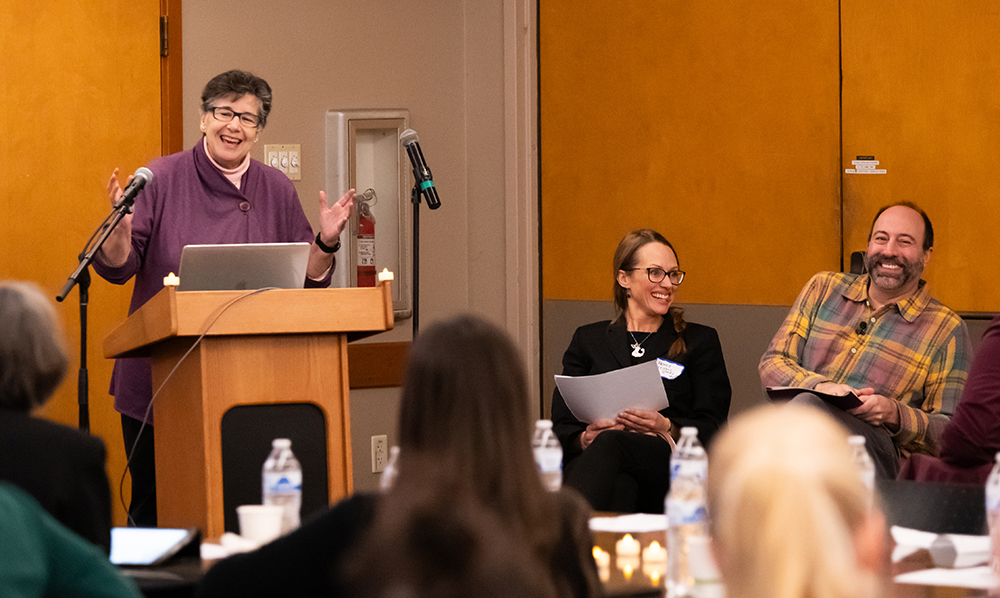
President Ana Mari Cauce waves hands enthusiastically while Monika Sengul-Jones, in black, and Ryan Calo, in plaid, laugh.
University of Washington President Ana Mari Cauce, left, at the inaugural convening of Society + Technology at the UW, together with Monika Sengul-Jones, center, and Ryan Calo, two leaders of the initiative. (Doug Parry)

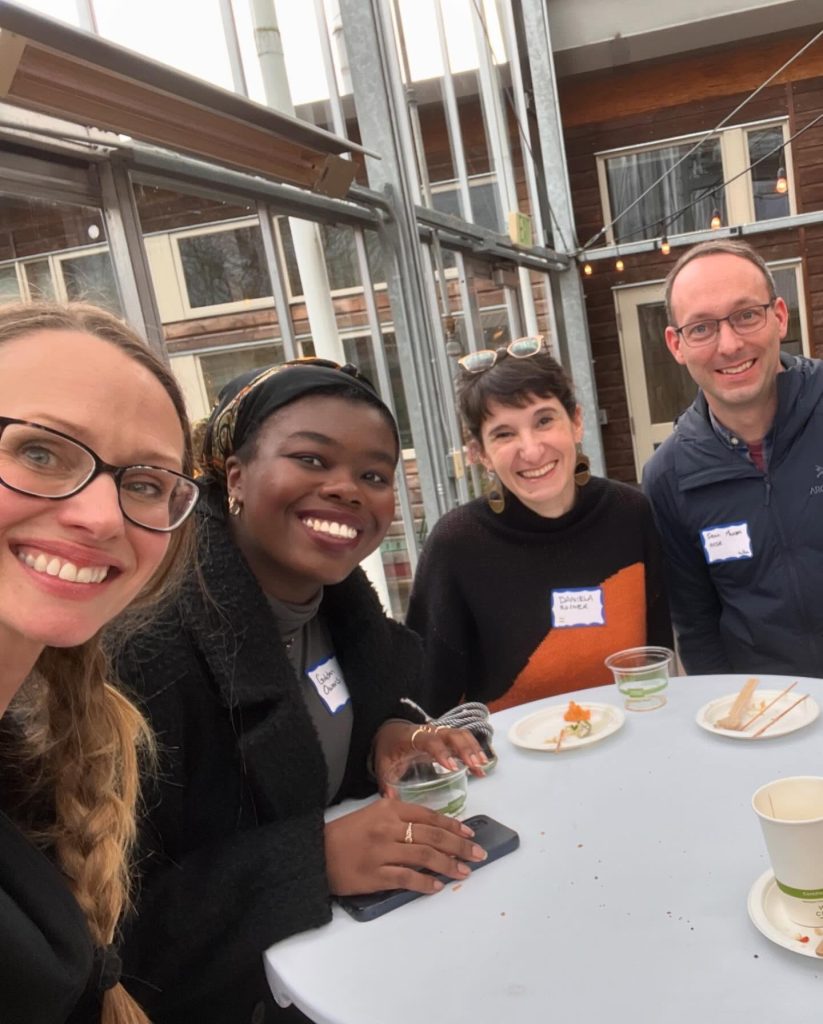
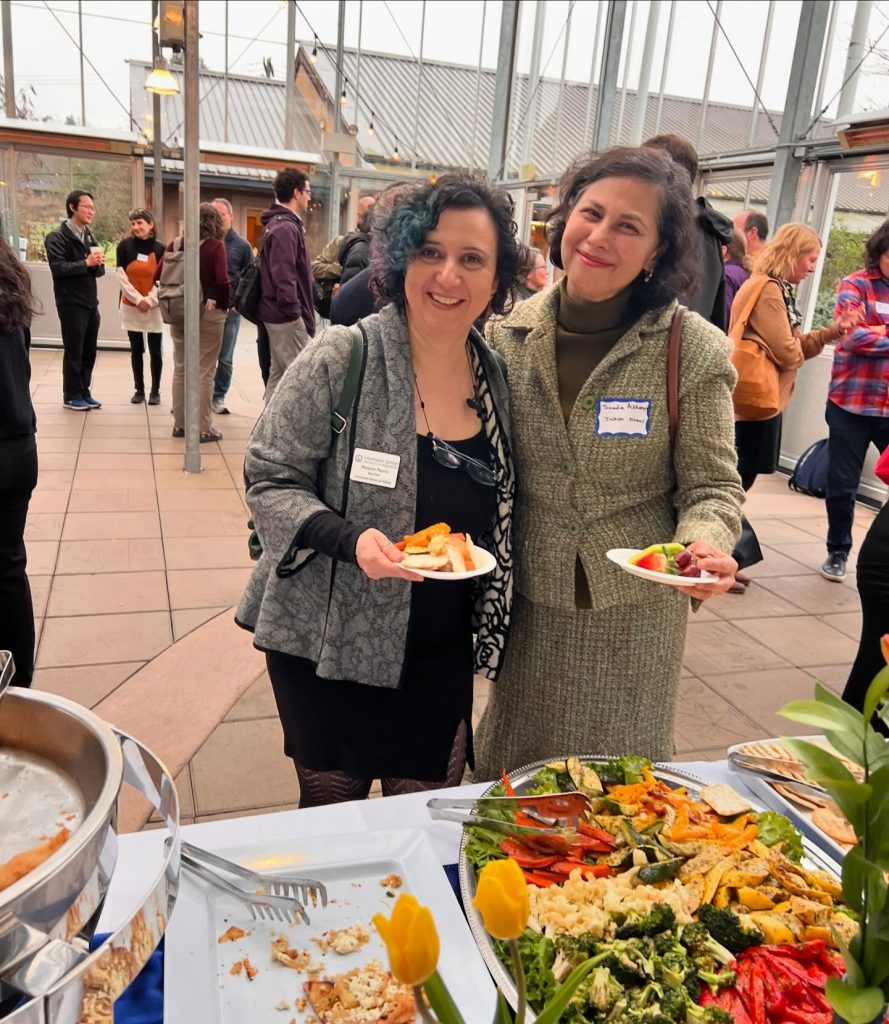
On January 10, 2025, over 80 faculty leaders from three campuses and the School of Medicine gathered at the UW Center for Urban Horticulture to launch Society + Technology at UW.

The kickoff began with remarks from university leadership. UW President Ana Mari Cauce referenced the 2022 Task Force chaired by Ryan Calo, which highlighted the vast scope of UW’s expertise in technology and society.

“[T]his is an area where the University of Washington has the brainpower [and] the people power,” said Cauce. 

Provost Tricia R. Serio emphasized the university’s commitment to the commons—the public good—and underscored the importance of supporting the ongoing work between the centers, programs, and labs across UW’s regional campuses.

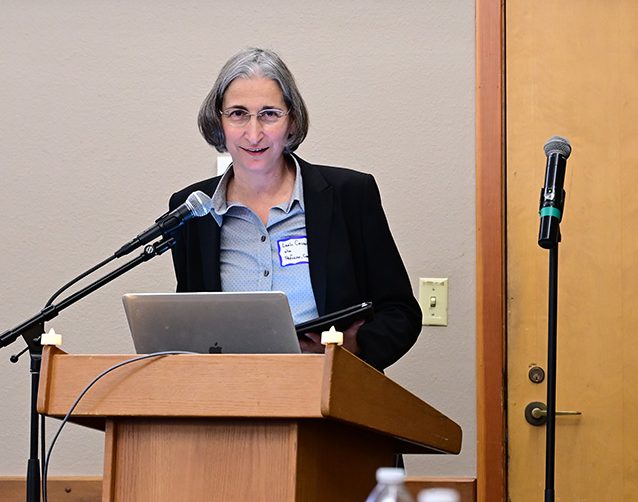
The initiative’s faculty lead is School of Law Professor Ryan Calo, who emceed the event. The speaker line-up began with Communication Professor Leah Ceccarelli, who directs the Science, Technology, and Society Studies (STSS) Graduate Certificate Program and has been involved in Society + Technology at UW since its inception.

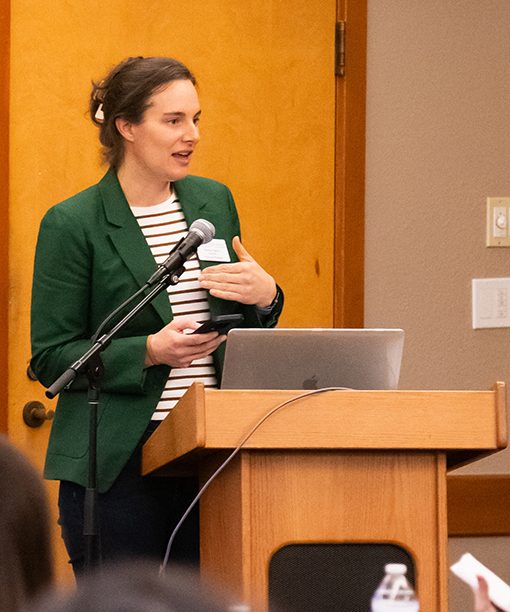
The event also featured speakers from the initiative’s growing network of faculty and staff—spanning more than 30 centers and 85 researchers—who shared insights on technology and research topics ranging from democracy, ethics, equity, historical context, artificial intelligence, and accessibility.

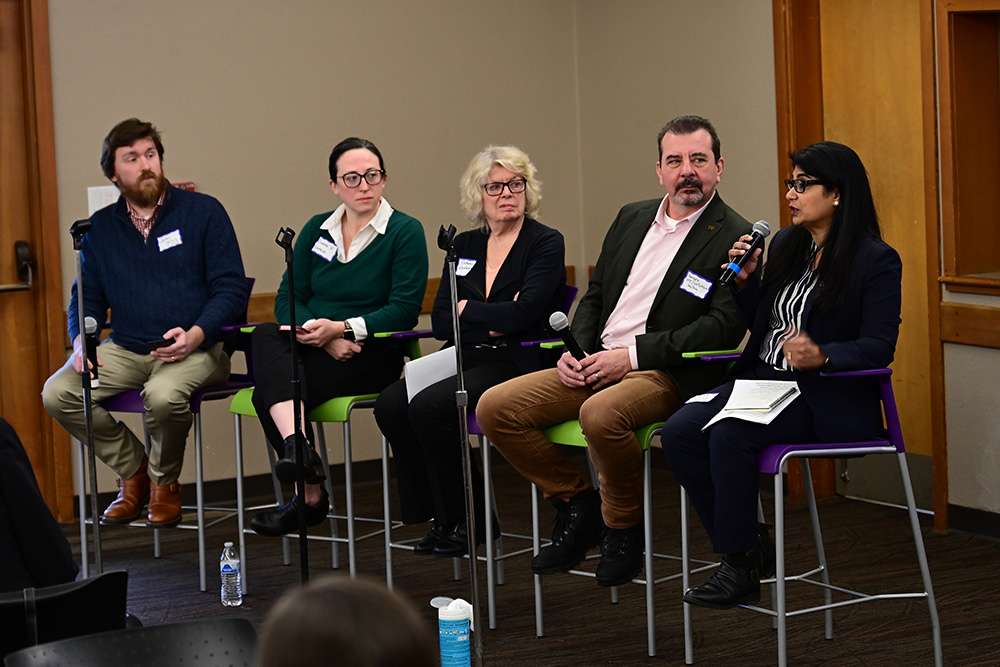
Jason Young (TASCHA, Researchers in Community, iSchool, UW Seattle), with Constance McBarron (EarthLab), Kathleen Woodward (Simpson Center for the Humanities), François Baneyx (CoMotion), and Divya McMillin (Innovation and Global Engagement, UW Tacoma), speaking at the opening of Society + Technology at UW. (Matthew Weinstein)

Society + Technology at UW has several community programs, including the First Monday STSS Reading Group, which focuses on the science, technology, and society studies intellectual community, a salon series, which began with events on bioethics and genetics, and pop-up working groups. The latest working group series, on science, society, and justice, is hosted by Tim Brown, an assistant professor in the Department of Bioethics and Humanities at the School of Medicine.

Planning for future events in Tacoma, Seattle, and Bothell is underway. Already on the calendar is a salon titled Technology for the People, scheduled for Monday, April 14, 2025 from 6 pm – 8 pm, co-hosted with the Department of Communication’s Center for Journalism, Media, and Democracy.

On September 3, Society + Technology at UW will co-host a UW gathering during the annual conference for the Society for Social Studies of Science (4S) association, which will be in Seattle in early September. Several affiliates are on the 4S conference planning leadership team.

To expand the reach of UW’s expertise, Society + Technology at UW plans to launch an external affiliates program for future community and industry partners in coming months.

Society + Technology at UW has been featured in articles from the Information School and GeekWire. In an interview with Geekwire writer Kurt Schlosser, Monika Sengul-Jones, Society + Technology at UW’s Director of Strategy and Operations, which is hosted in the UW Tech Policy Lab, explained the significance of the cross-disciplinary network’s focus.

“We put society first, very intentionally, in the name of the initiative, and in the idea that society makes technology,” Sengul-Jones said. “It’s not that tech just comes from nowhere and then suddenly impacts society. We all make it. We are extensions of the tools that we create.”

Speaker Line-Up and Event Details for Inaugural Convening Announced

The speaker line-up and event details for the Society + Technology at UW Inaugural Convening this Friday, Jan. 10 from 9 am to 12:30 pm at the Center for Urban Horticulture have been announced. Registration is still open—access the details here.

The morning event marks the launch of this new initiative. The program will begin with remarks from President Ana Mari Cauce and Provost Tricia Serio, as the initiative is an outgrowth of the 2021-22 President and Provost Task Force on Technology and Society. The program will also feature lightning talks from affiliated researchers, a panel discussion, opportunities to meet colleagues, and a light fare reception.

The event is co-sponsored by the UW Tech Policy Lab with support from the Office of the Provost.

University of Washington launches Society + Technology with focus on AI and emerging technologies

Hosted in the Tech Policy Lab, the program is the outcome of the 2022 Presidential Task Force on Technology & Society

Society + Technology at the University of Washington is a new program that uplifts an emergent network of faculty, students, researchers, staff, and programs across all of the UW’s three campuses (Bothell, Seattle, and Tacoma) and the School of Medicine around the social, societal, and justice aspects of technology. The program’s focus this spring is research, teaching, and learning around emerging technologies such as artificial intelligence (AI).

Hosted at the UW Tech Policy Lab, Society + Technology is an outcome of the 2022 UW Technology and Society Task Force research report, Leading the Way in Addressing the Societal Impacts of Emerging Technology, (PDF) charged by the President and the Office of the Provost. The report emphasized the responsibility of the University of Washington to provide leadership as state, federal, and international policymakers grapple with technological changes.

Given the tremendous expertise and wisdom within the University, Society + Technology seeks to facilitate new pathways for cutting-edge research and generative collaborations to happen, creating openings for new questions and research meaningful for our times and futures to unfold. 

Society + Technology co-hosts and co-sponsors free events and convenings, such as the interdisciplinary panel about AI, Art, and Copyright on May 2 with the Simpson Center for the Humanities, moderated by Melanie Walsh (Information School).

On May 8, Society + Technology hosts “The Model Hacker? The Intersection of AI and Security Research,” a conversation with legal and computer science experts and technology activists co-organized with the Tech Policy Lab and leading online civil rights group the Electronic Frontier Foundation on the evolution of research on AI, security, and hacking–and potential impacts on society, policy, and human flourishing.

Stay tuned for even more programming and resources in the months to come. 

Details about Society + Technology events are available on the program’s Trumba calendar and via the program’s listserv.

Join the listserv

Interested in partnering? Email program manager Monika Sengul-Jones at mmjones@uw.edu