Ontological choreography. Paradigm shifts. Boundary-work. Infrastructure as media. Value capture. Philosopher-in-residence.
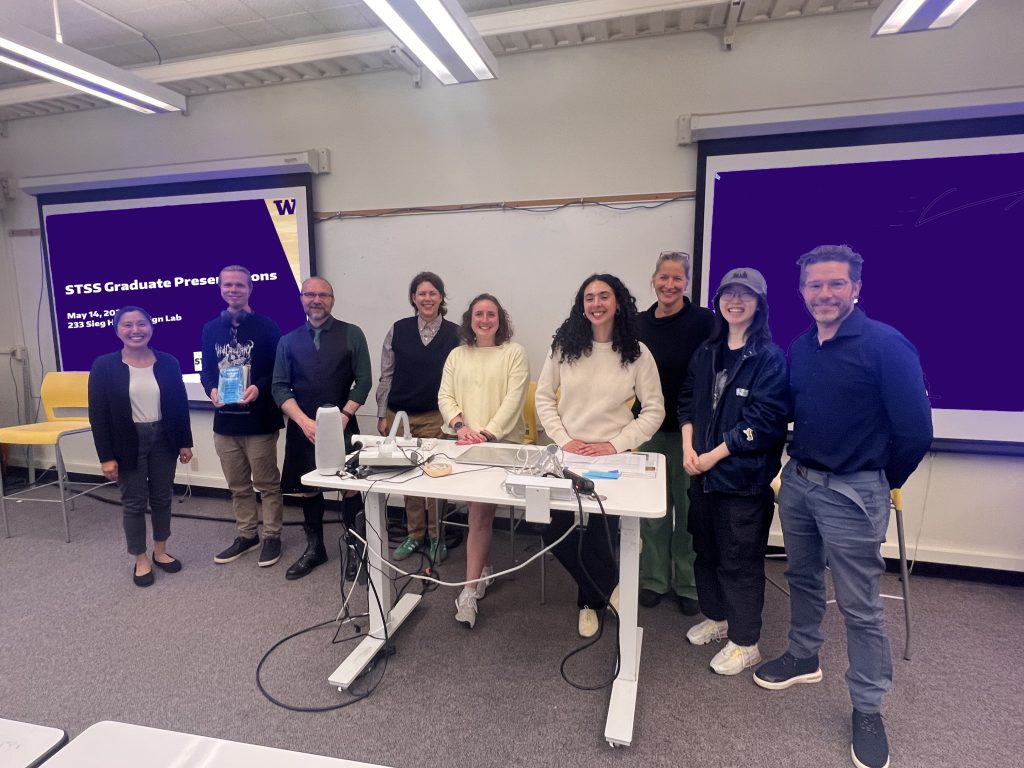
These are a few of the thematic keywords and phrases referenced during the portfolio presentations on May 14, 2026, by the five graduates of the Science, Technology, and Society Studies (STSS) graduate certificate program: Erica Bigelow, Rachael Diamond, Rin Huang, Cameron Musard, and Dan Tibbles.
The purpose of the STSS portfolio is for students to showcase how their research and teaching activities connect to the certificate’s learning objectives, which include learning to contextualize STEM fields in their social, historical, ethical, and policy contexts and building the critical reasoning skills needed to address complex problems at the intersection of science, technology, and society. The presentations are also a chance for graduates to connect their STSS learning to their own professional goals.
In the words of Tibbles, who is in the MA program in Bioethics and Humanities in the School of Medicine, the interdisciplinary ethos of STSS is shifting from seeking to understand to asking, “What systems made this look natural, responsible, funny, objective, or inevitable?” he said during his presentation, “Zooming Out.”
During his time in STSS, Tibbles brought his work in game design to bear on research about epigenetic gene editing.
Huang, an MA student in Cinema and Media Studies, described how STSS led her to consider space, technologies, and geography in her research on visions of the future in aviation.
Musard, who studied at Seattle Central’s Wood Technology Center and is now completing an MA in Urban Planning, described his engagement with STSS as demarcating tensions between carpentry and related professional categories such as architecture, construction labor, and woodworking through economic history, philosophy of education, and planning theory.
Bigelow, a doctoral candidate in philosophy, studied the ethics of large language models in clinical settings and broadened her reach as a philosopher-in-residence at Rainier Beach High School in Seattle.
Diamond, a communication scholar who will begin a PhD program at Northwestern in the fall, gestured to her work in climate activism as spurring her curiosity about STSS. Through her courses, she began to research the conditions under which people trust science.
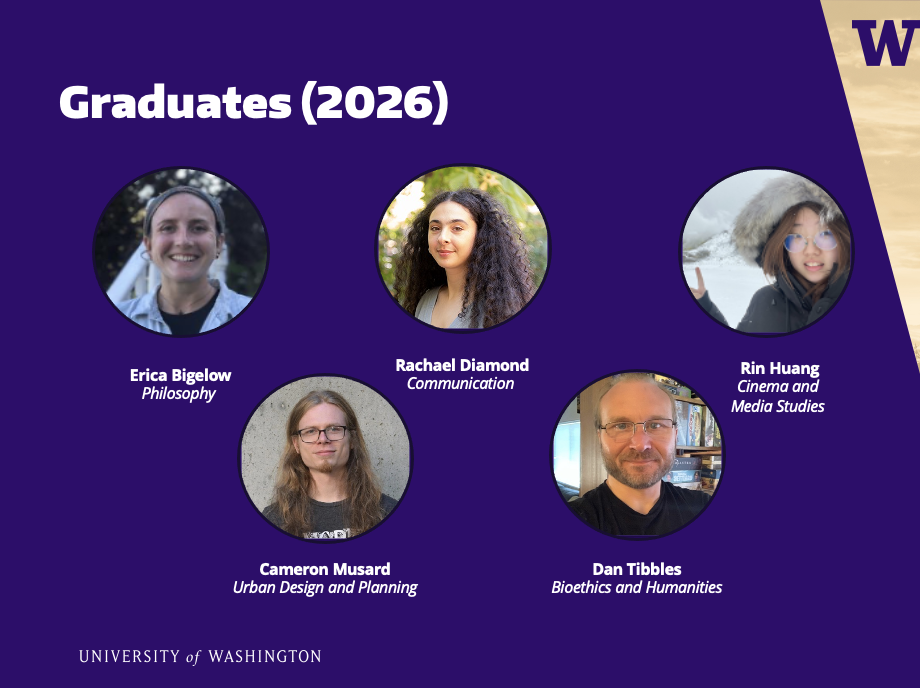
The graduates come from five disciplines—philosophy, communication, cinema and media studies, urban design and planning, and bioethics and humanities—demonstrating the intellectual reach of STSS.
Outgoing steering committee member Matthew Weinstein (Education, UW Tacoma) and interim STSS director David Ribes (Human Centered Design and Engineering, UW Seattle) introduced and facilitated the event.
STSS became an official UW Graduate School certificate in 2015. This year’s cohort brings the total number of certificate graduates to 21.
Congratulations to the graduates and their STSS advisors!
Student Presenters
Dan Tibbles
Bioethics and Humanities
Advisor: Sara Goering (Philosophy)
Presentation: Zooming Out
Dan Tibbles is a graduate student in Bioethics & Humanities, Genetic Epidemiology, and Education, Equity, & Society at the University of Washington. His work sits at the intersection of bioethics, public health genetics, and science and technology studies, focusing on how institutional incentives, interpretive practices, and data infrastructures shape what biotechnologies become clinically available, how they are communicated, and whom they serve. Prior to academia, he spent two decades in the tabletop game industry as a designer, manager, and business owner, a background that informs his systems-oriented approach to ethics, infrastructure, and human choice.
Rachael Diamond
Communication
Advisor: Carole Lee (Philosophy)
Presentation: Science/Society Communication in a Warming World
Rachael Diamond is a second-year graduate student in the Department of Communication whose master’s thesis research examines climate science communication and the rhetoric of environmental activists. After earning her MA, she will start her PhD in philosophy at Northwestern University in the fall. Before coming to UW, she was a political organizer advocating for pro-climate policies and candidates, and studied philosophy at Scripps College.
Erica Bigelow
Philosophy
Advisor: Amanda Friz (Communication)
Presentation: Meeting and Making the Tech-Built World
Erica Bigelow is a PhD candidate in the Department of Philosophy whose dissertation studies the nature and extent of our moral obligations toward others’ emotions. She is a scholar of critical disability studies and is particularly interested in how online discourse shapes and interprets such obligations, and in rethinking feminist moral theories to meet the present moment.
Cameron Musard
Urban Design and Planning
Advisor: Daniela Rosner (Human Centered Design & Engineering)
Presentation: New-Wave Old-School Urban Planning (Retro-Planning): A Master Builder Imaginary
Cameron Musard, who studied Cabinetmaking and Architectural Millwork at Seattle Central College’s Wood Technology Center and is completing an MA in Urban Design and Planning, described his engagements with Science, Technology, and Society Studies (STSS) as demarcating Traditional Carpentry from related professions such as construction management, real estate development, architectural design, landscape and urban design, engineering, and civic leadership. Drawing on traditions in the philosophy of science, economic history, philosophy of education, and the sociology of knowledge, his work examines how distinct forms of expertise, craft knowledge, and professional authority are produced, transmitted, and institutionalized within the built environment.
Rin Huang
Cinema and Media Studies
Advisor: David Ribes (Human Centered Design & Engineering)
Presentation: Media, Modernization, Mobility
Rin Huang is a graduate student in Cinema and Media Studies, focusing on transportation and its media representations. They wonder how technologies, especially those related with aviation and aeromobility, create a dispersed imagination of globalization and modernization since 1920s.
Advisors
Sara Goering
Philosophy (UW Seattle)
Sara Goering is Professor of Philosophy and the Program on Ethics, and has affiliations with the Department of Bioethics and Humanities, and the Disability Studies Program. In addition, she currently leads the ethics thrust at the UW Center for Neurotechnology. She teaches courses in bioethics, ethics, philosophy of disability, feminist philosophy, and philosophy of medicine. She also spends time discussing philosophy with children in the Seattle public schools, through her role as the Program Director for the UW Center for Philosophy of Children.
Carole J. Lee
Philosophy (UW Seattle)
Carole J. Lee is Professor in the Department of Philosophy at the University of Washington, an Adjunct Professor at the Information School (iSchool), and Affiliate Faculty at the Center for an Informed Public, Center for Statistics and the Social Sciences, eScience Institute, Center for Studies in Demography and Ecology, and the Society + Technology Program. She studies the social structure of science from both normative and descriptive perspectives.
Amanda Friz
Communication (UW Seattle)
Dr. Friz is Assistant Professor of Rhetoric of Health and Medicine in the Department of Communication and an Associate Director of the Center for Communication, Difference, and Equity and its Heal Equity Action Lab. She is currently writing her first book, A New Materialist Critique for a Radical Politics of Pleasure, which proposes shifting the locus of feminist pleasure activism from liberal subjectivity toward a radically inclusive plurality as the basis for more equitable sexual relationships.
Daniela Rosner
Human Centered Design & Engineering, DXARTS (UW Seattle)
Daniela Rosner is Professor of Digital Arts and Experimental Media (DXArts) and Human Centered Design and Engineering (HCDE) at the University of Washington, where she serves as Associate Chair of External Affairs. She holds adjunct appointments in the Department of Gender, Women, and Sexuality Studies (GWSS) and the Allen School for Computer Science and Engineering (CSE). She also serves as an associate member of the Einstein Center for Digital Futures in Berlin, Germany.
David Ribes
Human Centered Design & Engineering (UW Seattle)
David Ribes is a Professor in the Department of Human Centered Design & Engineering at the University of Washington. Dr. Ribes’s research focuses on the sociotechnical facets of eScience and how research infrastructures can support scientific investigations across changes in technology, policy and social organization.