Rumors are a common way for people to make sense of uncertainty. Emerging technologies from social media to AI have been a boon to misinformation, however, and have sown not just rumors but confusion and distrust. These days, how do we know what to believe?
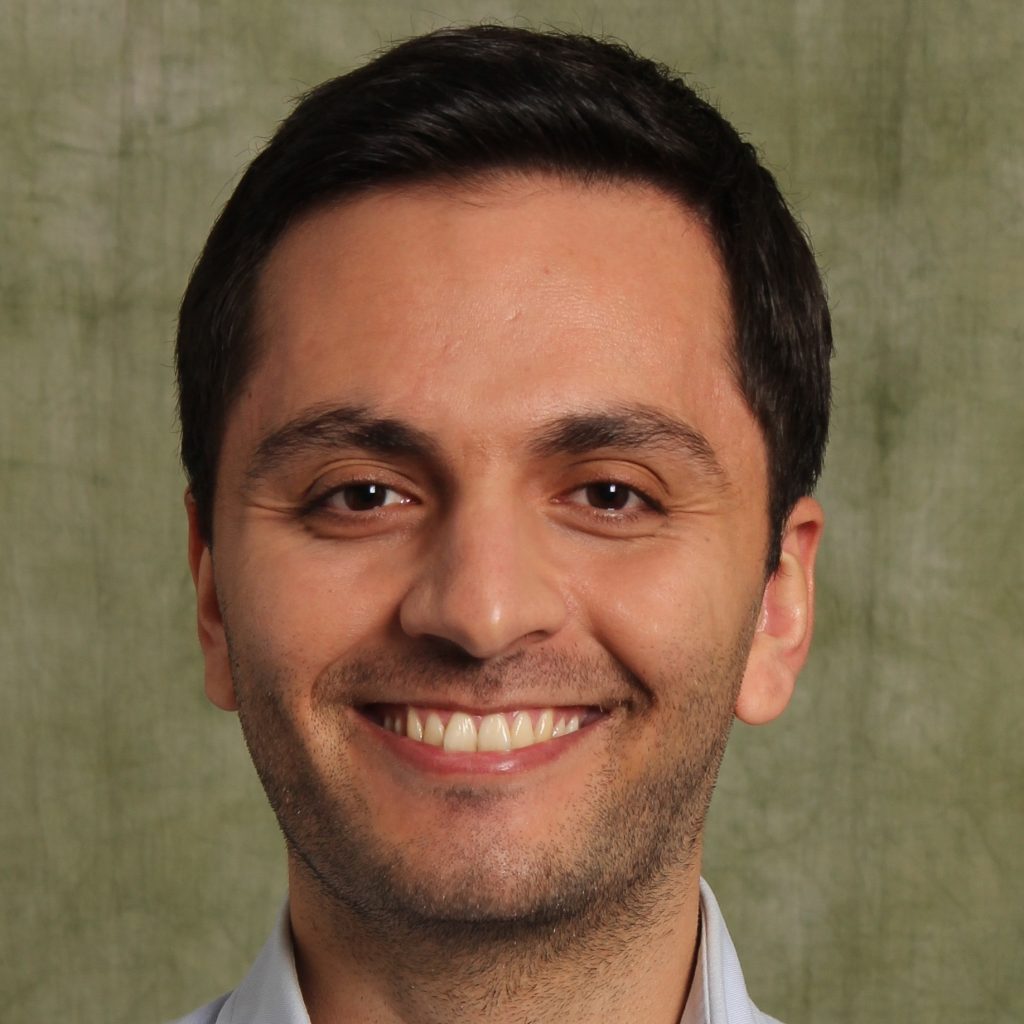
At our next S+T at UW After Hours, we’ll host the Center for an Informed Public’s Mert Can Bayar, who works on the Election Rapid Research team, in conversation with Monika Sengul-Jones, to talk about rumors, conspiracies, technology, and democracy. CIP’s research on election rumors has shown that misleading stories rarely rely on entirely fabricated evidence. More often, real events are misinterpreted, exaggerated, stripped of context, or assigned false intent.
Learn more about CIP’s work on election rumors as we approach the midterms and discuss over a drink. Free and open to the public (21+).
Monday, October 5, 2026 Lonely Siren | Sunroom 1501 Pike Pl Level 2 #200 Seattle, WA 98101 5:30 p.m.
Mert Can Bayar is an Assistant Teaching Professor of Data Visualization in the School of Interdisciplinary Arts & Sciences at UW Bothell and a researcher with the Center for an Informed Public in the Information School at the University of Washington, Seattle. His work focuses on public opinion, democracy, and conspiracy theories in a range of geopolitical settings, including Turkiye and the United States. Bayar earned his Ph.D. in Political Science from Binghamton University in 2023.
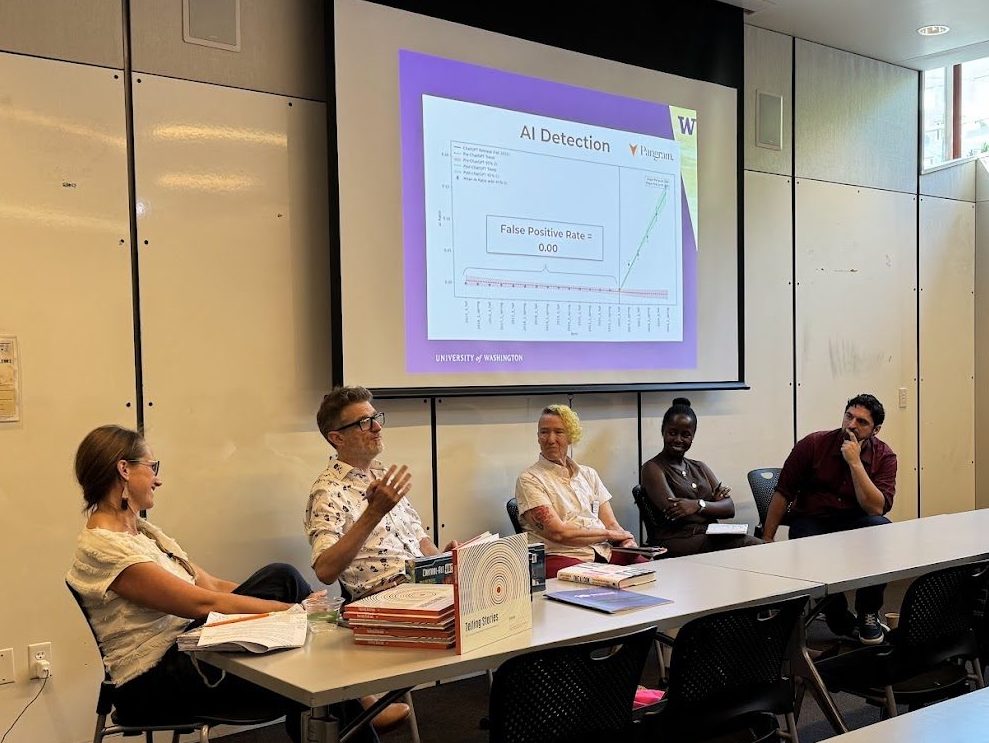
August 7, 2026 — Society + Technology at UW hosted a panel with UW researchers for the Communication Leadership AI Academy at UW Seattle, discussing how artificial intelligence is changing storytelling across communities.
The panel included Benjamin Mako Hill (Communication, UW Seattle), Russell Hansen (Communication, UW Seattle), Wes King (Information School, UW Seattle), and Ruth Karen Nakigozi (Informatics, UW Seattle). Monika Sengul-Jones moderated the conversation and presented her research on writing communities.
From left to right: Monika Sengul-Jones, Benjamin Mako Hill, Wes King, Ruth Karen Nakigozi, and Russell Hansen discussing AI detection software on a panel for the Communication Leadership’s AI Academy on Friday, Aug. 7, 2026. Credit: Raphaela Medeiros
Hansen, a doctoral candidate in the Department of Communication and researcher with the Center for Journalism, Media and Democracy (CJMD), observed how AI is impacting his studies of people who participate in political discussions on forums such as Reddit. Some participants are reluctant to share their experiences because they fear being identified through AI systems. He noted these concerns affect not only what participants are willing to disclose but also how researchers work.
Hill, an associate professor in the Department of Communication and a founding member of the Community Data Science Collective, introduced the concept of “disintermediation” to explain how large language models (LLMs) strip information of its provenance. He described how new AI features are threatening online communities such as open-access volunteer-run projects like Wikipedia, because readers are less likely to visit articles, examine sources, or become editors. Hill also noted the launch of Wikimedia Enterprise by the Wikimedia Foundation, a new service for commercial uses of Wikimedia projects.
King, an assistant teaching professor in the Information School, discussed AI in relation to their longstanding research on religion and religious communities. They referenced the Catholic Church’s recent interest in AI ethics, notably Pope Leo XIV’s first encyclical, Magnifica Humanitas, which calls for AI to be guided by human dignity. King also described religion’s uses of AI, such mining religious texts and pastors making digital twins.
Nakigozi, an undergraduate Informatics student and Tech Policy Lab intern, discussed the oral-history work she is conducting with Ben Lee (Information, UW Seattle) and Benjamin Shapiro (Computer Science, UW Seattle) on endangered languages. She also considered whether and how communities can use AI technologies for language preservation without allowing it to flatten what is distinctive about the community and their ways of being in the world.
Sengul-Jones, Director of Strategy & Operations for Society + Technology at UW and a writer and researcher, discussed how Pangram, a new AI-detection software, has fostered antagonism and competition among online writers and publishers. At the same time, working writers and editors report being asked to use AI tools and to “humanize” AI text, as noted in a recent webinar on writing and AI by professionals in a UW editorial certificate program. Sengul-Jones noted this may create opportunities for storytellers skilled in voice and emotional resonance. She also pointed out that the launch of LLMs has coincided with a surge in book publishing and available texts, potentially contributing to reader fatigue.
The discussion ranged to debate the adequacy of metaphors such as “empire” or “cartel” for describing political and economic power relationships to reflections on how norms in storytelling are changing with the availability of troves of information. Hill referenced an article by Ryan Ruby for the New Left Review and explained that a novel such as Herman Melville’s Moby-Dick, which famously includes long passages about whaling and sperm whales, may be less impressive today to readers who might find such descriptions boring — or even mistake them for “AI slop.” Other creative and ingenious forms of storytelling, perhaps not yet formed, may instead resonate with readers as norms evolve.
Bennett, Matthew, Ingrid Emerick, and David Hirning. “Expert Insights: How AI Is Changing Writing, Editing & Publishing.” UW Professional & Continuing Education, 6 Aug. 2026. Webinar.
Ruby, Ryan. “Wikipedia and the Novel.” New Left Review, no. 156, Nov.-Dec. 2025. https://newleftreview.org/issues/ii156/articles/ryan-ruby-wikipedia-and-the-novel
Saslow, Eli. “A Bay Area Pastor Made an A.I. Twin to Talk About God at Any Time.” Photographs by Erin Schaff, The New York Times, 30 July 2026. /07/30/us/ai-twin-pastor-justin-lester-california-church.html
Society + Technology at UW is pleased to cross-promote the next event in the Signals & Society series, Are We Still in Control?, a conversation with Chirag Shah (Information, UW Seattle), author of Agent Nation: How Autonomous AI Is Rewriting the Rules of Society—and What We Can Do About It, and Society + Technology at UW’s Ryan Calo (Law and Information, UW Seattle).
Have people handed control to AI? Signals & Society suggests this has “not happened in one dramatic moment, but incrementally. One “accept,” one skipped terms-of-service agreement, and one “let the app decide” at a time.”
In the conversation, Shah and Calo will discuss what’s happening when AI systems are given decision-making authority and what can be done next.
Free and open to the public (21+).
Monday, August 24, 2026, at 6:00 p.m. Lonely Siren 1501 Pike Place, Level 2, #200, Seattle
Topics include:
How autonomous AI is reshaping work, governance, and daily life
Who is accountable when AI agents act on our behalf
How people can reclaim agency in an increasingly automated society
About Chirag Shah
Chirag Shah is a professor in the UW Information School and the founding co-director of the Center for Responsibility in AI Systems & Experiences (RAISE). His research focuses on building, auditing, and correcting intelligent information systems. His latest book, Agent Nation, examines how autonomous AI is reshaping society and offers practical approaches to democratic governance and human-centered design.
About Ryan Calo
Ryan Calo is the Virginia and Prentice Bloedel Professor at the University of Washington, with appointments in Law, the Information School, and the Allen School. He is a co-founder of Society + Technology at UW, the Tech Policy Lab, and the Center for an Informed Public. His scholarship focuses on law and emerging technology, privacy, artificial intelligence, and robotics.
The mission of Society + Technology at UW’s fall symposium, The Power of Public Research, is to elevate the impact of UW’s research and teaching by advancing greater cross-disciplinary understanding, community, and empathy.
To do so, the symposium is organized around the threads of connection that emerge between and across keywords, which attendees are invited to approach as objects of focus and discussion:
War Privacy Risk Care Openness Tradition Expertise Authorship Diversity Conspiracy Profit Agency and Power
During the symposium, there will be lightning talks on each keyword, wherein affiliates with the Society + Technology at UW from across the campuses and School of Medicine will speak to and around each word.
This list of keywords is limited and not meant to include every important theme at the intersection of society and technology; rather, these are provocations and opportunities for connection.
It’s worth noting that the list does not name individual technologies or technological configurations, such as artificial intelligence, large language models, satellites, or quantum computing, though we expect these are of central concern to attendees. The keywords shift attention to ways of thinking across mediums, histories, and modes of research to consider how we might connect, dialogue, and advance work across fields, positions, and research agendas.
Following the lightning talks, attendees can discuss in Birds of a Feather conversations on each word facilitated by a lead convener from the Society + Technology at UW initiative.
The full lineup of speakers and lead conveners will be announced soon.
The symposium will open with remarks by UW Office of Research Vice Provost for Data Science Andrew Connolly (Astronomy, UW Seattle) and conclude with a Fireside Chat with Ryan Calo and Gabriel Solis, followed by stargazing, weather permitting.
Space is limited; register today and learn more about the program and our sponsors by visiting the program web page: www.societyandtechnology.uw.edu/symposium