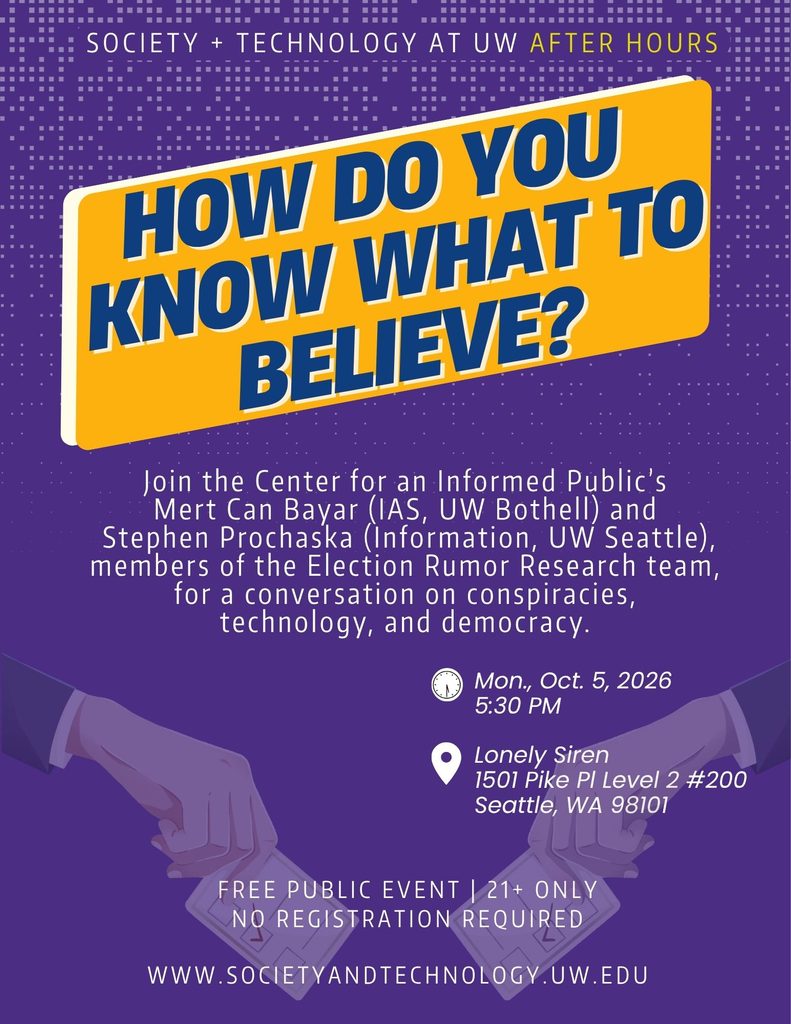
Rumors are a common way for people to make sense of uncertainty. Emerging technologies from social media to AI have been a boon to misinformation, however, and have sown not just rumors but confusion and distrust. These days, how do we know what to believe?
At our next S+T at UW After Hours, we’ll host the Center for an Informed Public’s Mert Can Bayar and Stephen Prochaska, who work on the Election Rapid Response team, in conversation with Monika Sengul-Jones, to talk about rumors, conspiracies, technology, and democracy. CIP’s research on election rumors has shown that misleading stories rarely rely on entirely fabricated evidence. More often, real events are misinterpreted, exaggerated, stripped of context, or assigned false intent.
Learn more about CIP’s work on election rumors as we approach the midterms and discuss over a drink. Free and open to the public (21+).
Monday, October 5, 2026
Lonely Siren | Sunroom
1501 Pike Pl Level 2 #200
Seattle, WA 98101
5:30 p.m.
Bios
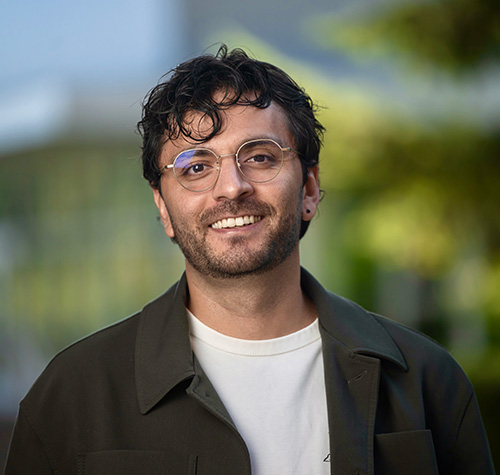
Mert Can Bayar is an Assistant Teaching Professor of Data Visualization in the School of Interdisciplinary Arts & Sciences at UW Bothell and a researcher with the Center for an Informed Public in the Information School at the University of Washington, Seattle. His work focuses on public opinion, democracy, and conspiracy theories in a range of geopolitical settings, including Turkiye and the United States. Bayar earned his Ph.D. in Political Science from Binghamton University in 2023.
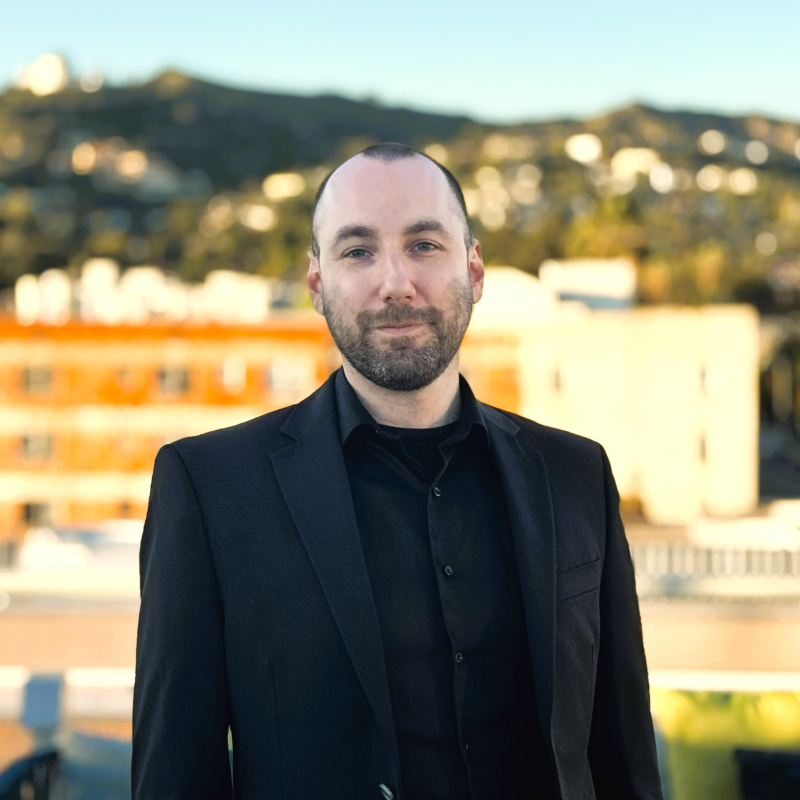
Stephen Prochaska is a PhD candidate in the Information School working with the Center for an Informed Public (CIP) at the University of Washington. His expertise focuses on understanding how digital collective sensemaking is manipulated to disseminate and reproduce propaganda and disinformation around U.S. elections. He examines how online audiences collaborate with political elites and digital influencers to assign meaning to ambiguous events, and how initial interpretations are guided and interrupted by propagandists who leverage historical narratives of online communities. Outside of academic publications, his work has been featured in MSNBC/MSNOW, the Spokesman Review, HuffPost, and Deutschlandradio, among other outlets.