August 7, 2026 — Society + Technology at UW hosted a panel with UW researchers for the Communication Leadership AI Academy at UW Seattle, discussing how artificial intelligence is changing storytelling across communities.
The panel included Benjamin Mako Hill (Communication, UW Seattle), Russell Hansen (Communication, UW Seattle), Wes King (Information School, UW Seattle), and Ruth Karen Nakigozi (Informatics, UW Seattle). Monika Sengul-Jones moderated the conversation and presented her research on writing communities.
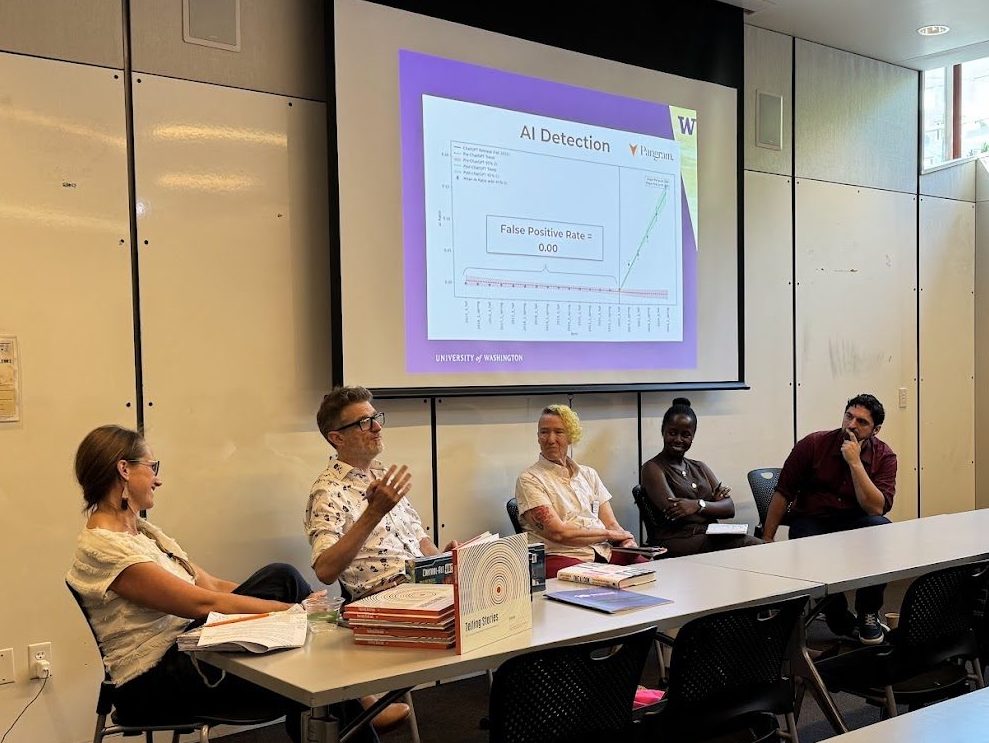
Hansen, a doctoral candidate in the Department of Communication and researcher with the Center for Journalism, Media and Democracy (CJMD), observed how AI is impacting his studies of people who participate in political discussions on forums such as Reddit. Some participants are reluctant to share their experiences because they fear being identified through AI systems. He noted these concerns affect not only what participants are willing to disclose but also how researchers work.
Hill, an associate professor in the Department of Communication and a founding member of the Community Data Science Collective, introduced the concept of “disintermediation” to explain how large language models (LLMs) strip information of its provenance. He described how new AI features are threatening online communities such as open-access volunteer-run projects like Wikipedia, because readers are less likely to visit articles, examine sources, or become editors. Hill also noted the launch of Wikimedia Enterprise by the Wikimedia Foundation, a new service for commercial uses of Wikimedia projects.
King, an assistant teaching professor in the Information School, discussed AI in relation to their longstanding research on religion and religious communities. They referenced the Catholic Church’s recent interest in AI ethics, notably Pope Leo XIV’s first encyclical, Magnifica Humanitas, which calls for AI to be guided by human dignity. King also described religion’s uses of AI, such mining religious texts and pastors making digital twins.
Nakigozi, an undergraduate Informatics student and Tech Policy Lab intern, discussed the oral-history work she is conducting with Ben Lee (Information, UW Seattle) and Benjamin Shapiro (Computer Science, UW Seattle) on endangered languages. She also considered whether and how communities can use AI technologies for language preservation without allowing it to flatten what is distinctive about the community and their ways of being in the world.
Sengul-Jones, Director of Strategy & Operations for Society + Technology at UW and a writer and researcher, discussed how Pangram, a new AI-detection software, has fostered antagonism and competition among online writers and publishers. At the same time, working writers and editors report being asked to use AI tools and to “humanize” AI text, as noted in a recent webinar on writing and AI by professionals in a UW editorial certificate program. Sengul-Jones noted this may create opportunities for storytellers skilled in voice and emotional resonance. She also pointed out that the launch of LLMs has coincided with a surge in book publishing and available texts, potentially contributing to reader fatigue.
The discussion ranged to debate the adequacy of metaphors such as “empire” or “cartel” for describing political and economic power relationships to reflections on how norms in storytelling are changing with the availability of troves of information. Hill referenced an article by Ryan Ruby for the New Left Review and explained that a novel such as Herman Melville’s Moby-Dick, which famously includes long passages about whaling and sperm whales, may be less impressive today to readers who might find such descriptions boring — or even mistake them for “AI slop.” Other creative and ingenious forms of storytelling, perhaps not yet formed, may instead resonate with readers as norms evolve.
The panel was a part of the two-week intensive AI Academy by the Communication Leadership program in the Department of Communication. Learn more at: https://commlead.uw.edu/academics/ai-summer-academy/
Notes
Bennett, Matthew, Ingrid Emerick, and David Hirning. “Expert Insights: How AI Is Changing Writing, Editing & Publishing.” UW Professional & Continuing Education, 6 Aug. 2026. Webinar.
Ruby, Ryan. “Wikipedia and the Novel.” New Left Review, no. 156, Nov.-Dec. 2025. https://newleftreview.org/issues/ii156/articles/ryan-ruby-wikipedia-and-the-novel
Saslow, Eli. “A Bay Area Pastor Made an A.I. Twin to Talk About God at Any Time.” Photographs by Erin Schaff, The New York Times, 30 July 2026. /07/30/us/ai-twin-pastor-justin-lester-california-church.html