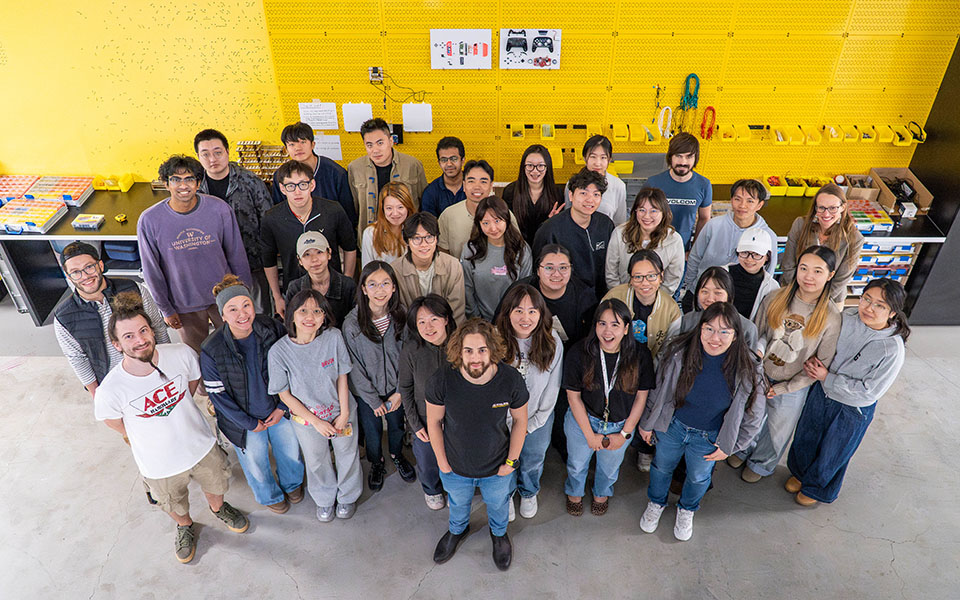
The second year of the S+T at UW and GIX partnership, the Master of Science in Technology Innovation (MSTI) course on responsible innovation, concluded for the 2026 spring quarter with presentations by students reenvisioning an established product in connected devices and robotics, including satellites, robotic arms, and augmented reality glasses, to better align the product with social values such as reducing harm, privacy, transparency, and security.
The course capstone emerged after students grappled with topics such as tech policy, data privacy, intention, emotion, communication, and security through readings, films, engagement activities, and guest lectures by four experts from the UW (bios below):
- Jessica L. Beyer, Assistant Teaching Professor of International Studies (UW Seattle) on information sharing and cybersecurity.
- Alex Bolton, Executive Director of the Teach Policy Lab (UW Seattle), who presented on technology policy and definitions of technology.
- Agnieszka Jeżyk, Maria Kott Endowed Assistant Professor of Polish Studies in Slavic Studies, on technology anxiety.
- Beth Kolko, Professor of Human Centered Design and Engineering Professor on responsible innovation and tech design.
In their reflections on the course, students said they not only appreciated the range of disciplinary expertise of the speakers but the unique engagement materials — which included fiction, films, panel events, historical case studies, games, news articles, and podcasts — all aimed to guide students to unexpected angles from which to consider responsibility and innovative design.
For instance, student Yewen Zhou noted that Jeżyk’s background in Polish studies, avant-garde literature, psychoanalysis, and Cold War material culture gave her a perspective on technology grounded in affect and lived experience that she hadn’t expected — but deeply appreciated.
“[Jeżyk’s] approach opened up questions about how people feel about technology, not just what technology does to them. That session was one of the most memorable parts of the course for me, partly because of the thoughtful inclusion of Ray Bradbury’s “There Will Come Soft Rains” (both the 1950 short story and the Soviet film from 1984) in the course material. It was such an impactful lead-up to the discussion — and having one of the questions I wrote on sticky notes answered during that class made the session feel perfectly integrated into my learning experience.”
Generally, assignments and in-class activities used multimodal techniques to encourage dialogue, reflection, and problem-solving around technological catastrophes and worst-case scenarios.
“I liked the day that we used an anonymous pad to write about bias in data science as a class collective,” wrote one in a final reflection, noting that people could write more freely than in open class discussions.
Another nontraditional assignment, “Walking with Her,” paired students to record a guided discussion of Spike Jonze’s 2013 film Her, in lieu of a traditional written response paper, prompting students to openly discuss intimacy, dating, artificial intelligence, and technological dependence with less stress.
“Responsible innovation can’t only live in policy documents and risk matrices, it also has to reckon with the cultural imagination and emotional reality around technology.”
Yewen Zhou, GIX Student
Students also maintained a 30-hour technology log to foster their own reflection of their technological habits and daily interactions with sociotechnical systems.
To prepare for security challenges, students used a “White Hat Hacking” red-teaming card deck developed by Tech Policy Lab co-founder Tadayoshi Kohno to help them think like adversaries so they could propose stronger, more resilient redesigns for their final projects.
A common theme crosscut the final presentations: engagement with the Responsible Innovation Labs toolkit, authored by Kolko, which helps early-stage founders anticipate how products and services can have an impact that goes beyond the intended users.
“Responsible innovation can’t only live in policy documents and risk matrices,” said Zhou, “it also has to reckon with the cultural imagination and emotional reality around technology.”
This is the second year of collaboration that brings affiliated scholars from across the UW community into a lecture series program for the course, The History and Future of Technology: Responsible Innovation.
Guest Speakers
(Alphabetical Order)
Jessica L. Beyer

Topic: Information Sharing and Cybersecurity
Jessica L. Beyer is an Assistant Teaching Professor in the Henry M. Jackson School of International Studies at UW Seattle and a leader of the school’s Cybersecurity Initiative. Her award-winning research examines international technology politics, online communities, and dis/misinformation, including projects on COVID-19 information flows and Internet of Things security. She is an expert in the politics of cybersecurity and mentors student research across multiple programs. Her work has been supported by the National Science Foundation, the Carnegie Corporation of New York, and the UW Population Health Initiative. Jessica is the author of Expect Us: Online Communities and Political Mobilization (Oxford University Press, 2014).
Alex Bolton

Topic: Tech Policy
Alex Bolton is Executive Director of the Tech Policy Lab at UW Seattle and a 2025-26 Non-Resident Research Fellow with the Siegel Family Endowment. The Tech Policy Lab is an interdisciplinary collaboration crossing the School of Law, the Information School, and the Paul G. Allen School of Computer Science & Engineering. Alex leads the strategy and programming, convenes campus-wide discussions on technology policy, and co-teaches courses on technology law, policy, and ethics. He is also a founding member of the Public Tech Leadership Collaborative Steering Committee, a program of Data & Society. Alex previously worked in state government and higher education, including for former Washington Governor and U.S. Senator Daniel J. Evans. He holds a J.D., M.P.A., and B.A. from the University of Washington.
Agnieszka Jeżyk

Topic: Tech Anxiety
Agnieszka Jeżyk is the Maria Kott Endowed Assistant Professor of Polish Studies in the Department of Slavic Languages and Literatures at UW Seattle. Her research focuses on marginal subjectivities, avant-garde literature, and representations of technology in Central and Eastern Europe, with an emphasis on psychoanalysis, horror, and material culture in the Cold War period. She has held academic positions at the University of California, Los Angeles and the University of Toronto. Her work connects literary and cultural analysis to broader questions about technology, affect, and modernity.
Beth Kolko

Topic: Responsible and Creative Innovation
Beth Kolko is a Professor in the Department of Human Centered Design & Engineering at UW Seattle. Her work focuses on human-centered entrepreneurship and the role of design in shaping more equitable forms of innovation. She leads initiatives such as REgroup, which brings together students, founders, and investors to rethink entrepreneurship, and previously directed labs focused on digital inclusion and technology design. Kolko is also co-founder and former CEO of Shift Labs, a company developing low-cost medical devices for emerging markets. Her career crosses academia, industry, and global consulting, with experience at Microsoft Research, the Berkman Klein Center at Harvard, and organizations in multiple countries.