Based in Seattle, GeekWire is an independent technology news organization covering innovation, science, startups, major technology companies, and the people and institutions shaping the Pacific Northwest’s technology ecosystem. GeekWire covered the launch of this initiative and S+T at UW’s effort to foster broad collaboration at the intersection of technology and society. Importantly, GeekWire is on the pulse of what’s happening in our tech-rich region more generally, with more than 80% of its readers tuning in from outside the Pacific Northwest. As its tagline puts it, “what happens here matters everywhere.”
This partnership indexes our shared commitment to connecting research, expertise, and public conversation—and to fostering opportunities for conversations about technology and society to move between the university and our broader community.
Society + Technology at UW welcomes interest from community organizations, nonprofits, media organizations, and industry groups who see value in what we’re building and would like to be part of it. To learn more about joining the Society + Technology at UW affiliate circle, email mmjones@uw.edu.
August 7, 2026 — Society + Technology at UW hosted a panel with UW researchers for the Communication Leadership AI Academy at UW Seattle, discussing how artificial intelligence is changing storytelling across communities.
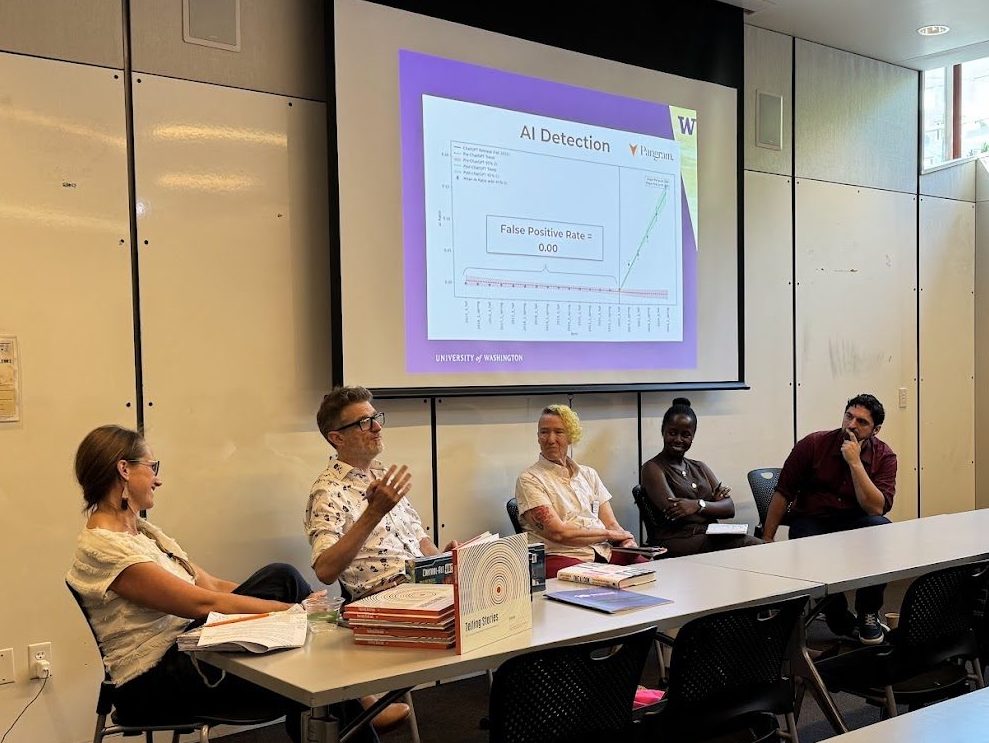
The panel included Benjamin Mako Hill (Communication, UW Seattle), Russell Hansen (Communication, UW Seattle), Wes King (Information School, UW Seattle), and Ruth Karen Nakigozi (Informatics, UW Seattle). Monika Sengul-Jones moderated the conversation and presented her research on writing communities.
From left to right: Monika Sengul-Jones, Benjamin Mako Hill, Wes King, Ruth Karen Nakigozi, and Russell Hansen discussing AI detection software on a panel for the Communication Leadership’s AI Academy on Friday, Aug. 7, 2026. Credit: Raphaela Medeiros
Hansen, a doctoral candidate in the Department of Communication and researcher with the Center for Journalism, Media and Democracy (CJMD), observed how AI is impacting his studies of people who participate in political discussions on forums such as Reddit. Some participants are reluctant to share their experiences because they fear being identified through AI systems. He noted these concerns affect not only what participants are willing to disclose but also how researchers work.
Hill, an associate professor in the Department of Communication and a founding member of the Community Data Science Collective, introduced the concept of “disintermediation” to explain how large language models (LLMs) strip information of its provenance. He described how new AI features are threatening online communities such as open-access volunteer-run projects like Wikipedia, because readers are less likely to visit articles, examine sources, or become editors. Hill also noted the launch of Wikimedia Enterprise by the Wikimedia Foundation, a new service for commercial uses of Wikimedia projects.
King, an assistant teaching professor in the Information School, discussed AI in relation to their longstanding research on religion and religious communities. They referenced the Catholic Church’s recent interest in AI ethics, notably Pope Leo XIV’s first encyclical, Magnifica Humanitas, which calls for AI to be guided by human dignity. King also described religion’s uses of AI, such mining religious texts and pastors making digital twins.
Nakigozi, an undergraduate Informatics student and Tech Policy Lab intern, discussed the oral-history work she is conducting with Ben Lee (Information, UW Seattle) and Benjamin Shapiro (Computer Science, UW Seattle) on endangered languages. She also considered whether and how communities can use AI technologies for language preservation without allowing it to flatten what is distinctive about the community and their ways of being in the world.
Sengul-Jones, Director of Strategy & Operations for Society + Technology at UW and a writer and researcher, discussed how Pangram, a new AI-detection software, has fostered antagonism and competition among online writers and publishers. At the same time, working writers and editors report being asked to use AI tools and to “humanize” AI text, as noted in a recent webinar on writing and AI by professionals in a UW editorial certificate program. Sengul-Jones noted this may create opportunities for storytellers skilled in voice and emotional resonance. She also pointed out that the launch of LLMs has coincided with a surge in book publishing and available texts, potentially contributing to reader fatigue.
The discussion ranged to debate the adequacy of metaphors such as “empire” or “cartel” for describing political and economic power relationships to reflections on how norms in storytelling are changing with the availability of troves of information. Hill referenced an article by Ryan Ruby for the New Left Review and explained that a novel such as Herman Melville’s Moby-Dick, which famously includes long passages about whaling and sperm whales, may be less impressive today to readers who might find such descriptions boring — or even mistake them for “AI slop.” Other creative and ingenious forms of storytelling, perhaps not yet formed, may instead resonate with readers as norms evolve.
Bennett, Matthew, Ingrid Emerick, and David Hirning. “Expert Insights: How AI Is Changing Writing, Editing & Publishing.” UW Professional & Continuing Education, 6 Aug. 2026. Webinar.
Ruby, Ryan. “Wikipedia and the Novel.” New Left Review, no. 156, Nov.-Dec. 2025. https://newleftreview.org/issues/ii156/articles/ryan-ruby-wikipedia-and-the-novel
Saslow, Eli. “A Bay Area Pastor Made an A.I. Twin to Talk About God at Any Time.” Photographs by Erin Schaff, The New York Times, 30 July 2026. /07/30/us/ai-twin-pastor-justin-lester-california-church.html
Society + Technology at UW is pleased to cross-promote the next event in the Signals & Society series, Are We Still in Control?, a conversation with Chirag Shah (Information, UW Seattle), author of Agent Nation: How Autonomous AI Is Rewriting the Rules of Society—and What We Can Do About It, and Society + Technology at UW’s Ryan Calo (Law and Information, UW Seattle).
Have people handed control to AI? Signals & Society suggests this has “not happened in one dramatic moment, but incrementally. One “accept,” one skipped terms-of-service agreement, and one “let the app decide” at a time.”
In the conversation, Shah and Calo will discuss what’s happening when AI systems are given decision-making authority and what can be done next.
Free and open to the public (21+).
Monday, August 24, 2026, at 6:00 p.m. Lonely Siren 1501 Pike Place, Level 2, #200, Seattle
Topics include:
How autonomous AI is reshaping work, governance, and daily life
Who is accountable when AI agents act on our behalf
How people can reclaim agency in an increasingly automated society
About Chirag Shah
Chirag Shah is a professor in the UW Information School and the founding co-director of the Center for Responsibility in AI Systems & Experiences (RAISE). His research focuses on building, auditing, and correcting intelligent information systems. His latest book, Agent Nation, examines how autonomous AI is reshaping society and offers practical approaches to democratic governance and human-centered design.
About Ryan Calo
Ryan Calo is the Virginia and Prentice Bloedel Professor at the University of Washington, with appointments in Law, the Information School, and the Allen School. He is a co-founder of Society + Technology at UW, the Tech Policy Lab, and the Center for an Informed Public. His scholarship focuses on law and emerging technology, privacy, artificial intelligence, and robotics.
On May 22, 2026, nearly thirty UW scholars and champions of feminist technoscience from across three campuses and disciplines gathered at UW Press for a Feminist Technoscience Meet-Up hosted by Society + Technology at UW after guest-of-honor Ly Xīnzhèn M. Zhǎngsūn Brown’s public lecture, “What Does Law Mean in Crisis? How Crip Feminist Technoscience Will Save Us,” held the previous evening at Town Hall Seattle.
Ly Xīnzhèn M. Zhǎngsūn Brown
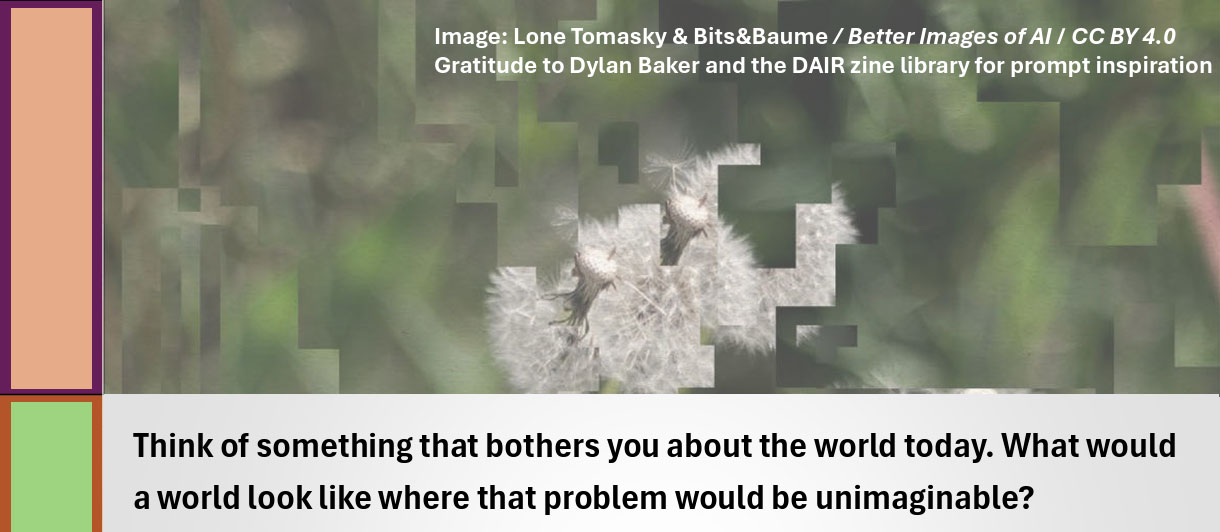
Rather than organizing the gathering around formal presentations or introductions, participants were invited to bring an “object of wisdom and wonder” that might glitch, jolt, or reconfigure technologies, systems, or infrastructures toward greater survival now and thriving then.
The prompt was inspired by Brown’s provocation, “in the shadow of an empire, in a world on fire, what if we could imagine—and build—otherwise?”
Participants took turns sharing their objects: a handmade deck of cards, a zine that imagines techno-futures, a Cambodian krama, a photograph of a beloved collaborator, a heavy calligraphy pen, stickers with instructions on box breathing, an interpreter and moment of translation, and Brown’s observation that they are a technology of contradiction.
A snippet of the prompt on a collaborative student zine that Associate Professor of Social Work Clara Berridge brought as her object of wisdom and wonder, created by students in her course, “Social Welfare and AI: Power, Ethics, and Social Impacts. Credit: Clara Berridge.
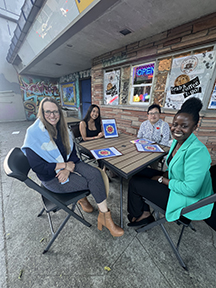
From left: Monika Sengul-Jones, Vannary Sou, Ly Xīnzhèn M. Zhǎngsūn Brown, and Ruth Karen Nakigozi at Senait Ethiopian Restaurant in Lake City, Seattle.
Society + Technology at UW fosters greater cross-campus and cross-disciplinary collaborations on the social, societial, and ethical aspects of technology through community programs like this.
The Feminist Technoscience mixer was co-sponsored by UW Press, Gender, Women & Sexuality Studies (GWSS), the UW Tech Policy Lab, and CREATE.
Special thanks to the undergraduates from the Tech Policy Lab, which hosts Society + Technology at UW, who helped make the experience of gathering go smoothly: Vannary Sou, Ruth Karen Nakigozi, and Raani Nigam. And thanks to Brown for sharing their love for Ethiopian cuisine afterwards.