Rumors are a common way for people to make sense of uncertainty. Emerging technologies from social media to AI have been a boon to misinformation, however, and have sown not just rumors but confusion and distrust. These days, how do we know what to believe?
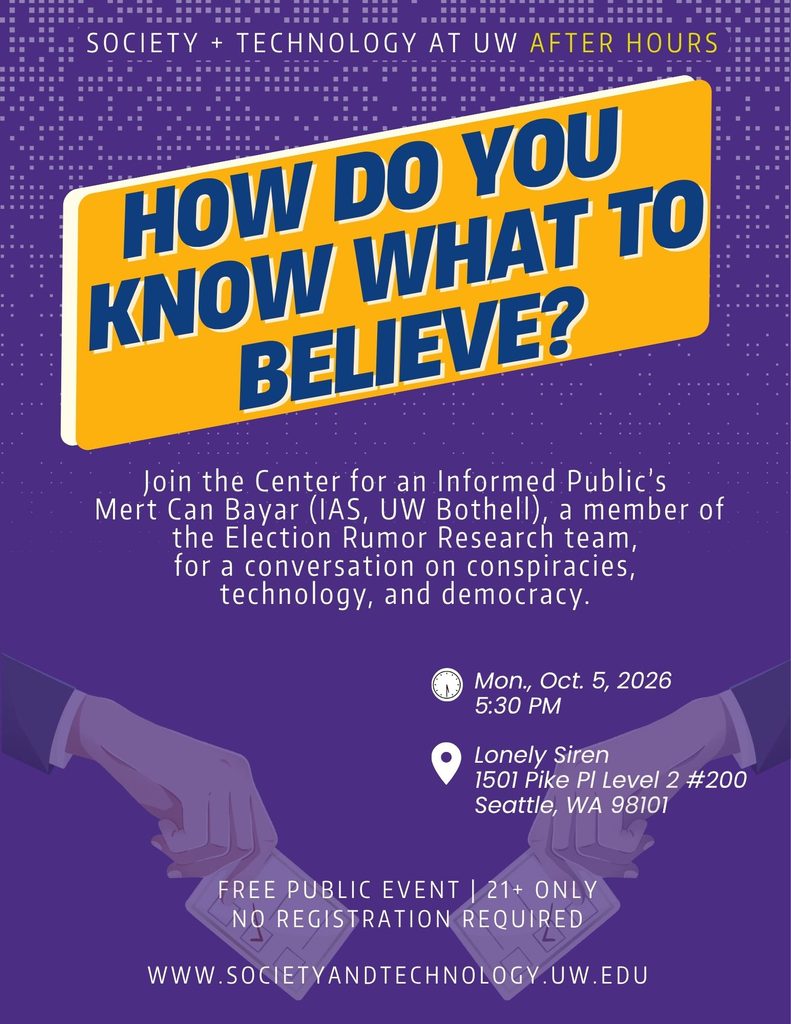
At our next S+T at UW After Hours, we’ll host the Center for an Informed Public’s Mert Can Bayar, who works on the Election Rapid Response team, in conversation with Monika Sengul-Jones, to talk about rumors, conspiracies, technology, and democracy. CIP’s research on election rumors has shown that misleading stories rarely rely on entirely fabricated evidence. More often, real events are misinterpreted, exaggerated, stripped of context, or assigned false intent.
Learn more about CIP’s work on election rumors as we approach the midterms and discuss over a drink. Free and open to the public (21+).
Monday, October 5, 2026 Lonely Siren | Sunroom 1501 Pike Pl Level 2 #200 Seattle, WA 98101 5:30 p.m.
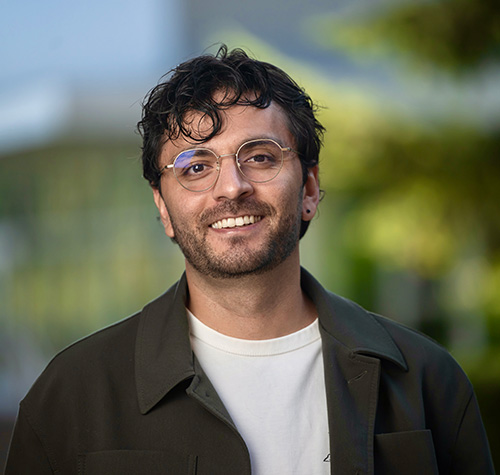
Mert Can Bayar is an Assistant Teaching Professor of Data Visualization in the School of Interdisciplinary Arts & Sciences at UW Bothell and a researcher with the Center for an Informed Public in the Information School at the University of Washington, Seattle. His work focuses on public opinion, democracy, and conspiracy theories in a range of geopolitical settings, including Turkiye and the United States. Bayar earned his Ph.D. in Political Science from Binghamton University in 2023.
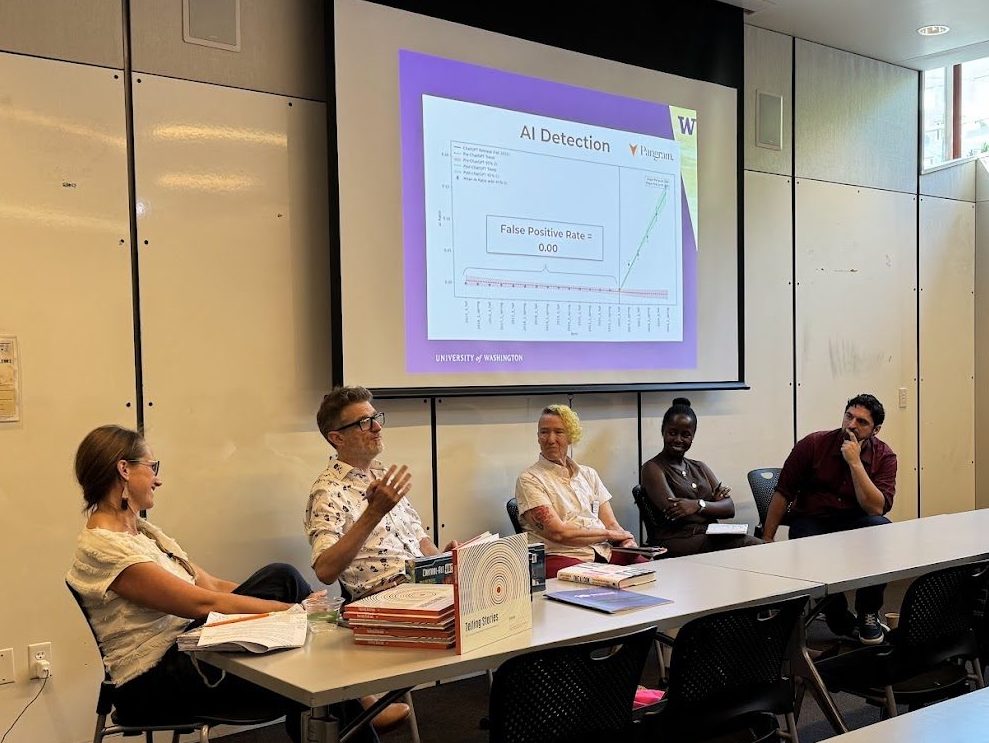
August 7, 2026 — Society + Technology at UW hosted a panel with UW researchers for the Communication Leadership AI Academy at UW Seattle, discussing how artificial intelligence is changing storytelling across communities.
The panel included Benjamin Mako Hill (Communication, UW Seattle), Russell Hansen (Communication, UW Seattle), Wes King (Information School, UW Seattle), and Ruth Karen Nakigozi (Informatics, UW Seattle). Monika Sengul-Jones moderated the conversation and presented her research on writing communities.
From left to right: Monika Sengul-Jones, Benjamin Mako Hill, Wes King, Ruth Karen Nakigozi, and Russell Hansen discussing AI detection software on a panel for the Communication Leadership’s AI Academy on Friday, Aug. 7, 2026. Credit: Raphaela Medeiros
Hansen, a doctoral candidate in the Department of Communication and researcher with the Center for Journalism, Media and Democracy (CJMD), observed how AI is impacting his studies of people who participate in political discussions on forums such as Reddit. Some participants are reluctant to share their experiences because they fear being identified through AI systems. He noted these concerns affect not only what participants are willing to disclose but also how researchers work.
Hill, an associate professor in the Department of Communication and a founding member of the Community Data Science Collective, introduced the concept of “disintermediation” to explain how large language models (LLMs) strip information of its provenance. He described how new AI features are threatening online communities such as open-access volunteer-run projects like Wikipedia, because readers are less likely to visit articles, examine sources, or become editors. Hill also noted the launch of Wikimedia Enterprise by the Wikimedia Foundation, a new service for commercial uses of Wikimedia projects.
King, an assistant teaching professor in the Information School, discussed AI in relation to their longstanding research on religion and religious communities. They referenced the Catholic Church’s recent interest in AI ethics, notably Pope Leo XIV’s first encyclical, Magnifica Humanitas, which calls for AI to be guided by human dignity. King also described religion’s uses of AI, such mining religious texts and pastors making digital twins.
Nakigozi, an undergraduate Informatics student and Tech Policy Lab intern, discussed the oral-history work she is conducting with Ben Lee (Information, UW Seattle) and Benjamin Shapiro (Computer Science, UW Seattle) on endangered languages. She also considered whether and how communities can use AI technologies for language preservation without allowing it to flatten what is distinctive about the community and their ways of being in the world.
Sengul-Jones, Director of Strategy & Operations for Society + Technology at UW and a writer and researcher, discussed how Pangram, a new AI-detection software, has fostered antagonism and competition among online writers and publishers. At the same time, working writers and editors report being asked to use AI tools and to “humanize” AI text, as noted in a recent webinar on writing and AI by professionals in a UW editorial certificate program. Sengul-Jones noted this may create opportunities for storytellers skilled in voice and emotional resonance. She also pointed out that the launch of LLMs has coincided with a surge in book publishing and available texts, potentially contributing to reader fatigue.
The discussion ranged to debate the adequacy of metaphors such as “empire” or “cartel” for describing political and economic power relationships to reflections on how norms in storytelling are changing with the availability of troves of information. Hill referenced an article by Ryan Ruby for the New Left Review and explained that a novel such as Herman Melville’s Moby-Dick, which famously includes long passages about whaling and sperm whales, may be less impressive today to readers who might find such descriptions boring — or even mistake them for “AI slop.” Other creative and ingenious forms of storytelling, perhaps not yet formed, may instead resonate with readers as norms evolve.
Bennett, Matthew, Ingrid Emerick, and David Hirning. “Expert Insights: How AI Is Changing Writing, Editing & Publishing.” UW Professional & Continuing Education, 6 Aug. 2026. Webinar.
Ruby, Ryan. “Wikipedia and the Novel.” New Left Review, no. 156, Nov.-Dec. 2025. https://newleftreview.org/issues/ii156/articles/ryan-ruby-wikipedia-and-the-novel
Saslow, Eli. “A Bay Area Pastor Made an A.I. Twin to Talk About God at Any Time.” Photographs by Erin Schaff, The New York Times, 30 July 2026. /07/30/us/ai-twin-pastor-justin-lester-california-church.html
Society + Technology at UW is pleased to host the next After Hours conversation in Tacoma, Living “At Risk” with anthropologist Lisa M. Hoffman (Urban Studies, UW Tacoma) and computer scientist Josh D. Tenenberg (Engineering, UW Tacoma) in conversation about the stakes, technologies, and stories of high risk.
What if you’re living with “high risk” for future disease? Maybe it is a genetically identified risk, maybe it is family history risk. What do you do with that knowledge—and who decides what disease risk means and how you should live?
Monday, May 18, 2026 | 5:30 PM Peaks & Pints Taproom (21+ only) 3816 N. 26th Street Tacoma, WA 98407
What does it mean to live with a “high” disease risk in our contemporary moment—and how does it differ from earlier formations of “risk factors”?
How genetic risk scores are shaping screening, reproduction, and everyday decision-making
Who interprets risk data? What is at stake in continuous recalculations of risk with new technologies?
What happens when you resist or refuse?
Faculty, students, community members, and curious citizens are welcome. Free and open to the public. No registration required.
About Lisa Hoffman
Lisa Hoffman is a Professor in the School of Urban Studies at UW Tacoma. An anthropologist, Hoffman’s current research focuses on Seattle’s biotech community, precision medicine, and the shape of contemporary practices of living in relation to genetic risk. Her work offers attunement to place, power, and subjectivity. Previously, Hoffman’s major projects included work on professionals and volunteers in contemporary China.
About Josh D. Tenenberg
Josh D. Tenenberg is a Professor in the Department of Engineering at UW Tacoma. His expertise is in what he calls the “borderlands” of technical and humanistic approaches. Trained in computer science, Tenenberg’s empirical research has been about computing and engineering education, software development, human-computer interaction, design research, semiotics, and technical communication. His publications include Narratives of Qualitative Research: Making Praxis Visible, published by Routledge (2024). He teaches human-oriented aspects of computing at the undergraduate and graduate levels.
A series about emerging technologies and their societal impact, making sense of big questions about today and tomorrow with experts from Society + Technology at UW’s Affiliate network.
EPISODE 3
Computer scientist Katharina Reinecke‘s virtual lab, LabintheWild, creates engaging quizzes to help make computer science more inclusive. Read the transcript to learn more.
Transcript
Monika Sengul-Jones
You’re a computer scientist leading the LabintheWildvirtual lab, which runs quizzes to help make computer science more inclusive. What led you to this work?
Katharina Reinecke
For my master’s thesis in Rwanda, I built software for agriculture advisors that I thought was intuitive, but everyone hated it. The colors, the design. People are different, right? And differences influence what people find usable, what they find appealing—what they like.
That experience taught me that design isn’t one-size-fits-all. It’s important to develop technology that is inclusive. We can’t just assume what we, or let’s say, a bunch of Silicon Valley developers, decide on is intuitive to everyone.
Monika Sengul-Jones
I love this story, and of course, that makes sense. How did the experience change your work in computer science?
Katharina Reinecke
Initially, I thought, OK, I know people need different user interfaces. So, my PhD thesis was on designing culturally-adaptive user interfaces (UI).
Monika Sengul-Jones
How did you figure out what different people need so that the UI would be relevant?
Katharina Reinecke
That’s a great question—and honestly, one I’m still exploring. In my PhD, I tried to predict what people might like based on their cultural backgrounds. It kind of worked—people performed better when they liked the design—but the model wasn’t great because we lacked real data on preferences. So during my postdoc at Harvard, I built LabintheWild, a website with fun experiments like “Compare your visual preferences to others.” One study went viral and got 40,000 participants from around 180 countries. This input gave me real insight into what people find visually appealing. Now, LabintheWildcan use that data to help designers customize websites for different audiences.
Monika Sengul-Jones
Very cool. I tried the tests on LabintheWild—and I recommend this to everyone, because it is this kind of partnership you have with your research subjects. They get to learn a little bit about themselves, too.
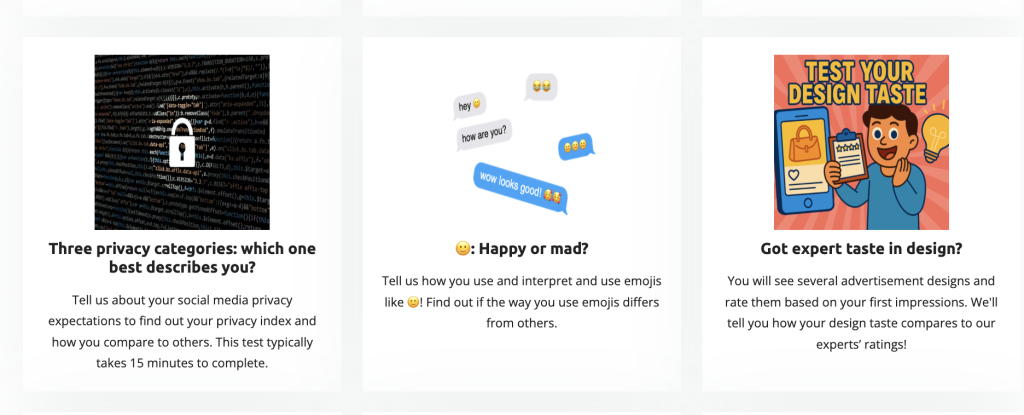
Screengrab of LabintheWild‘s homepage, which offers a range of quizzes that provide insight into user preferences and cultural differences, according to Reinecke.
The questions remind me of the internet in the earlier days, Buzzfeed was famous as a website for self-help quizzes, right? Like, what’s your spirit animal or what kind of partygoer are you? It’s fun, there’s an emotional satisfaction. It seems like your work is fostering a partnership with your research subjects.
Katharina Reinecke
Yeah, I think people find these quizzes satisfying. We’re trying to be more scientific than BuzzFeed; we’re not predicting your spirit animal [laughter], but we do try and make the results pages informative.
Monika Sengul-Jones
Totally. Who participates? Do you recruit?
Katharina Reinecke
Over the years, we’ve found people come from all over the internet. A newspaper will report on the lab. At one point, we got a lot of participants from bodybuilder.com. Reddit and Bored Panda have directed people to us. We actually did some studies looking into why people are coming and their motivations.
It’s diverse, just as people are. Some of them come because they just want to have fun and just, you know, test themselves. Some want to help science, especially the older population.
Some want to compare themselves to others. That is in line with some psychological theory; people love social comparison. Comparison helps us understand ourselves.
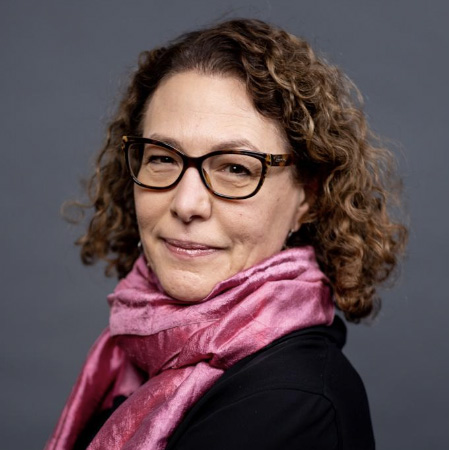
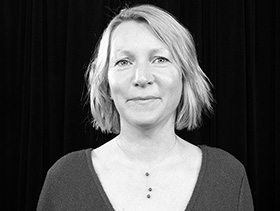
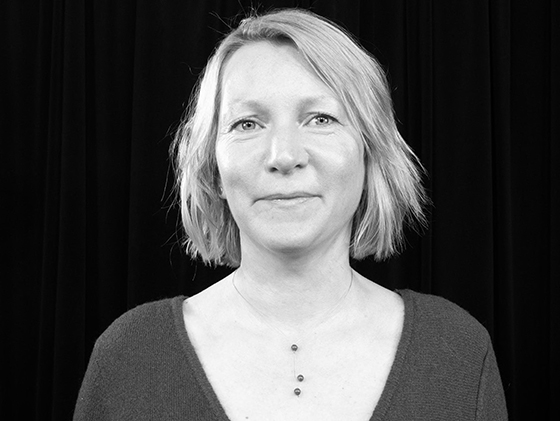
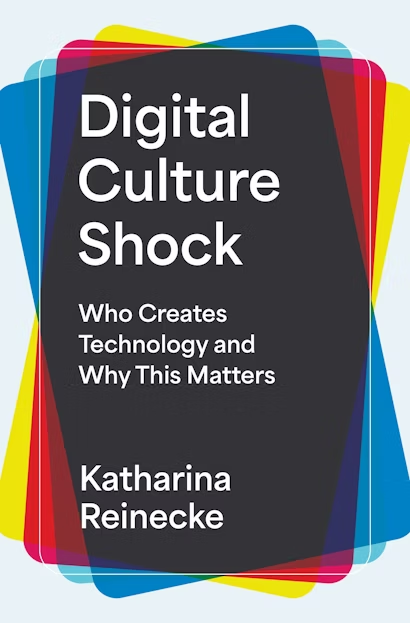
Computer scientist Katharina Reinecke believes non-inclusive user interfaces cause harm. Her new book Digital Culture Shock (Princeton University Press, to be published in Aug. 2025) helps engineers apply her research findings to design more inclusively. Credit: Russell Hugo
Monika Sengul-Jones
How do your research findings make computer science technologies more inclusive?
Katharina Reinecke
Really good question.
We often build software that people use to reach particular groups, based on their differences. We aim to make our data and findings publicly available on the LabintheWild website. Like most academics, we write, give talks and conference presentations, work with students, and consult with companies and organizations.
Monika Sengul-Jones
What happens when technologies aren’t inclusive?
Katharina Reinecke
People are left behind. Some people won’t be able to use the software. One of my students studies dyslexia. If you don’t design a user interface for that group, they might not be able to read it. People with screen readers are another example. Exclusion has real-world consequences. People are left behind.
Bias in a dataset can impact who gets a loan, who gets a job, and medical treatment. When we don’t verify how we train our models to include the range of human variability, there’s a range of severity in what could happen when that falls short.
Exclusion has real-world consequences. People are left behind. Bias in a dataset can impact who gets a loan, who gets a job, and medical treatment.
Katharina Reinecke
Monika Sengul-Jones
I’m struck by what you said about people being left behind, or simply not trusting the user interface. What happens when we still must use systems that don’t work for us?
Katharina Reinecke
I’ve thought about this question for a long time. We use websites often, throughout our lives; every day, we visit 100 different websites. This adds up. If the software systems you use don’t feel intuitive or make you feel like an outsider, and you still use them, either you’re going to change yourself to adhere to the values presented in those systems, or you’re going to be slowed down, experiencing friction like repetitive paper cuts.
Monika Sengul-Jones
You have a new book coming out. Tell us more?
Katharina Reinecke
The book is about digital culture shock. Technology systems that are designed in a Western context and transplanted to other parts of the world. Often, technologists release a software system and assume the need is ubiquitous, that it should look the same everywhere. The book is for software developers and the general public to learn more about how to design technology differently.
Katharina Reinecke’s new book is about the mismatch of design and cultural differences, and how software engineers can do better.
Monika Sengul-Jones
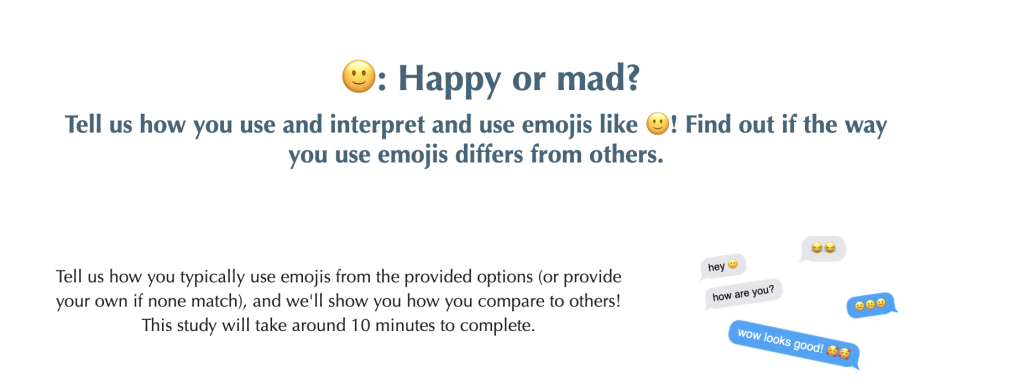
Thank you for this conversation and for your work with LabintheWild! I am heading over to take a quiz now to see if my understanding of emojis are shared by others. I mean, for some time now, I’ve used the melting face emoji 🫠 to signal overwhelm. Then someone told me it’s flirtatious embarressment! Oops. Given I might be an outlier, I want to contribute my important insights on meaning to research program—🙃 [laughter]. Do you want to help, too? Here’s the link!
Learn more
Preorder Digital Culture Shock, published by Princeton University Press, and get it delivered to your mailbox this summer. Katharina Reinecke’s book officially hits the shelves on August 5, 2025.
Image Credit: Portrait of Katharina Reinecke (2024) by Russell Hugo of the Language Learning Center (LLC). This transcript was edited for clarity by Monika Sengul-Jones. In-kind support for this interview was provided by the University of Washington’s Language Learning Center and the UW Tech Policy Lab.